40 years ago, the Space Shuttle Challenger disaster changed Central Floridians' lives
Published in News & Features
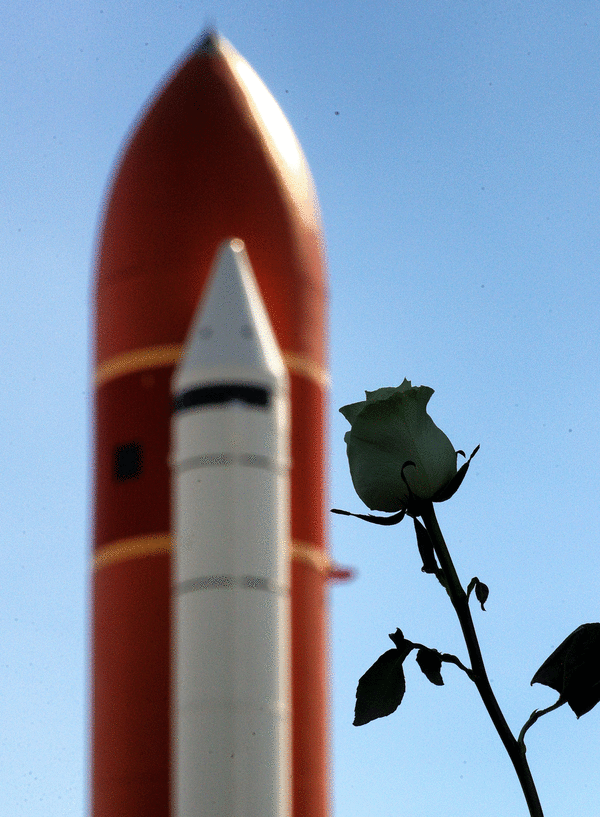
Their eyes were watching. Some knew something was wrong. Others were slow to realize. Soon everyone came to grief.
Forty years ago Space Shuttle Challenger climbed into the clear amid blue skies over Cape Canaveral. The nation’s youth watched on TVs across the nation and from school playgrounds across Central Florida.
Christa McAuliffe was to be the first teacher in space.
But the streak of the rocket’s plume did not look right.
“We definitely didn’t know what happened at the time, but you could feel the energy of the teachers,” said Elizabeth Wisner Stroz, now 51, then an 11-year-old in sixth grade at Brookshire Elementary in Winter Park on Jan. 28, 1986. “I remember them scurrying us in a classroom, and just the energy of the teachers was off.”
She was one of several students interviewed by the Orlando Sentinel on the day Challenger exploded, killing all seven of its crew 73 seconds after liftoff from Kennedy Space Center on the 25th mission of the Space Shuttle Program. The crew included commander Francis R. (Dick) Scobee, pilot Michael J. Smith, Ronald E. McNair, Ellison Onizuka, Gregory Jarvis, Judith Resnick and McAuliffe.
Over the past week, the Sentinel has revisited some of those students and other witnesses, including former members of its own staff, to find that the horrors of the explosion still linger. Challenger taught NASA hard lessons, including the importance of truly prioritizing safety, and the shame of failure. For those who watched, the lessons were simpler but no less profound: No matter what the experts say, tragedy can strike at any time. And while the events will recede, they never really stop hurting.
For Wisner Stroz, the launch was especially exciting. The mother of one of her friends and classmates, elementary science resource teacher Suzanne Ackley, had been a finalist among Florida candidates for the Teachers in Space program, which ultimately had 12,000 applicants across the nation.
She said teachers had rolled out a big old tube TV. The class watched some of the coverage afterward, but teachers shut it down because they knew something had tragically gone wrong.
“I remember going home and praying for these families,” she said.
Photos of Stroz and and her classmates Bobby Maisenholder, Stephanie Hooks and Jimmy Smeenge show desolate faces, as if questioning how and why this could happen.
“I just remember being so sad,” she said. “To know that they died … I do remember that distinctly.”
The experience was so jarring to the youth of America that President Ronald Reagan, when addressing the nation that evening, spoke directly to the children who had witnessed it.
“I know it is hard to understand, but sometimes painful things like this happen,” Reagan said. “It’s all part of the process of exploration and discovery. It’s all part of taking a chance and expanding man’s horizons. The future doesn’t belong to the fainthearted; it belongs to the brave. The Challenger crew was pulling us into the future, and we’ll continue to follow them.”
A job to do
For then 29-year-old Sentinel reporter James Fisher, the aftermath hit hard.
“When you’re a journalist, you’re thinking about, ‘What’s the narrative here. I’m telling a story to people, my readers. … What information do I need?'” he recounted. “So for about two to three days, that’s where my mind was at.”
It was just after that, he said, when he was driving home to his apartment in Cape Canaveral and he had to pull over.
“I just started to cry. And I cried deeply for, I don’t know how long in my car at the side of the road. It was the first time that I really … was able to express it,” he said. “I’m getting teary now, just thinking about it . You pull yourself together and you carry on.”
Having covered the shuttle program for much of the 1980s, he recalled how NASA had been preparing to up the pace of launches that year.
“There was a sense of trust. There was a sense of NASA would always call off a launch,” he said, noting the Challenger mission had already faced a series of scrubs that week. “There was this sense of, ‘They know what they’re doing.'”
When he talked to McAuliffe, she had the same feeling.
“I asked her about this. … ‘You’re going to go up in this bomb, essentially. Are you afraid?’ And she said, ‘No.’ She said exactly that. ‘I trust that they know what they’re doing.'”
He went on to cover the Challenger investigation hearings in Washington before retiring from journalism in 1989. Those hearings revealed how engineers had raised red flags about the dangers that cold weather posed to the O rings within the shuttle’s solid rocket boosters, which were ultimately blamed for the explosion. But those warnings were ignored.
“To watch them tell this story of the back-and-forth of the conversation and the pressure that they felt, and the scientific evidence that they presented based on their engineering skill, and yet being pressured to cave. … I saw what can happen when someone is forced to break the sanctity of their own values and ethics. And it was horrifying.”
Through a lens
Sentinel photographer Red Huber, who had covered most of the previous 24 shuttle launches, recalled the confusion of some in the crowd — and the growing realization of others. He shot the launch from Astronaut Road, where the Apollo Saturn V Center is today.
“When I saw the solid rocket booster going off to the side, I said, ‘Oh, this is not good.’ I knew there was something terribly wrong,” he said. “When that explosion happened, when it started to break apart, I knew there was something going on, but there were some ‘oohs’ and ‘ahs’ in the crowd, and I knew that they’d never seen it before, and so they didn’t know what to expect.”
Huber went on to cover every shuttle mission after that, retiring from the Sentinel in 2018. But he remembers the excitement of the Challenger crew and the NASA employees that were there to cheer them on.
“To me, it was electrifying,” he said. “The pep in their step, when they came out of the astronaut headquarters. … It gave you goosebumps.”
That moment of happiness is what stays with him, even though the days to come were full of tragedy.
“What comes to my mind always is the smile on Christa’s face, the waving, the smiles of all the astronauts.”
Lessons learned
The Challenger explosion came 19 years after NASA’s first major tragedy, the deaths of the three Apollo 1 astronauts during a routine test on the launch pad in 1967. NASA suffered again with the destruction of Space Shuttle Columbia 17 years later in 2003. And again, the agency had to look inward to challenge a culture that put safety at risk for the sake of progress.
Now, each year, the agency holds a Day of Remembrance on the fourth Thursday of January, as all three tragedies’ anniversaries fall within just six days of one another.
A renewed commitment to safety, NASA leadership says, is now clearly the No. 1 priority.
“They aren’t statistics. They were colleagues, parents, friends and explorers who accepted the risk because they believed in what we were doing. Their sacrifices aren’t in vain,” NASA Administrator Jared Isaacman said. “They’re why we improve safety, why we challenge outdated processes, and why we evolve our mission.”
Those lessons are front and center with the forthcoming Artemis II mission, a crewed, 10-day lunar flyby. It’s the first time humans will have been that far from Earth since the end of the Apollo program in 1972.
The risk isn’t lost on the Artemis II crew.
“I went on a walk with my with my kids, I told them, ‘Here’s where the will is, here’s where the trust documents are, and if anything happens to me, here’s what’s going to happen to you,'” said commander Reid Wiseman. “And that’s just a part of this life. I actually wish more people in everyday life would talk to their families in that way, because you never know what the next day is going to bring.”
_____
©2026 Orlando Sentinel. Visit orlandosentinel.com. Distributed by Tribune Content Agency, LLC.






Comments