Gen Z rejects 'radioactive' diet sodas for 'Zero Sugar' ones
Published in News & Features
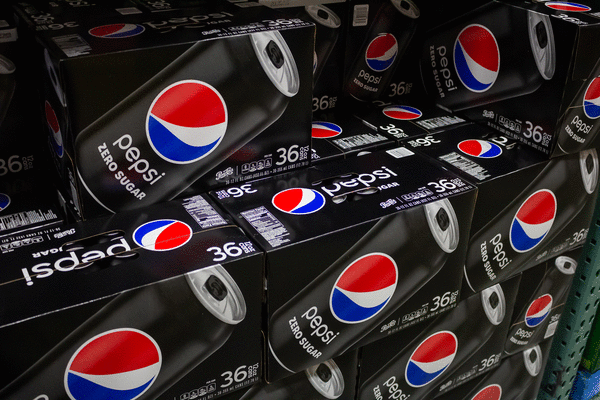
The first Pepsi Challenge tour in 50 years didn’t feature regular or even Diet Pepsi. Instead, the blind taste-test showdown last year pitted Pepsi Zero Sugar against Coca-Cola Zero Sugar.
At the Super Bowl next month, it’s Zero Sugar that will star in the beverage company’s Pepsi commercial, not the original formula. PepsiCo Inc. is running a 30-second spot, which can run more than $8 million, to hype the no-calorie drink.
“We’ve gone all in” on Pepsi Zero Sugar in the last two years, said Ram Krishnan, the chief executive officer of PepsiCo North America, so much so that the vast majority of its Pepsi marketing budget is spent promoting Zero Sugar.
It’s not just Pepsi. Across the soda aisle, Diet is out and Zero Sugar is in. Keurig Dr Pepper Inc, for one, didn’t have a single Zero Sugar offering in 2020. Now it has more than 40.
Diet and Zero Sugar are calorie free imitations of sugar-filled sodas. They’re both artificially sweetened, including with some aspartame — a chemical that The World Health Organization has classified as “possibly carcinogenic” at high levels, but the U.S. Food and Drug Administration says is safe.
Yet, Zero Sugar’s branding resonates more with younger, wellness-minded consumers, who shun sugar but don’t vibe with calorie counting or diet culture.
“The word ‘diet’ is from a different era. For a lot of younger consumers, it’s radioactive,” said Kevin Ryan, chief executive officer of Malachite Strategy and Research.
Last year a viral TikTok likened Diet Coke to a “fridge cigarette”: a guilty, unhealthy pleasure that takes the edge off. Zero Sugar, on the other hand, has more of a “health halo,” Krishnan, the Pepsi executive, said.
Zero Sugar sodas are a small but growing part of U.S. soft drink sales. Last year, they accounted for 52% of the category’s sales growth, according to Circana data provided to Bloomberg. Pepsi and Coke sold more of their Zero Sugar offerings in the first nine months of 2025 than the same period a year prior. Sales of full sugar Pepsi and Coke declined during that time, as did Diet Pepsi. Diet Coke was up slightly.
It’s a sharp turn for soda’s fortunes in the U.S., where sales by volume have fallen 27% over the last two decades as more consumers opt for water and energy drinks instead.
PepsiCo’s success with its Zero Sugar soda represents a bright spot for the company, which has struggled elsewhere to adapt to changing tastes. The soda and snack-maker’s shares have posted annual declines for the past three years, which made it the target of an activist investor.
Elliott Investment Management took a roughly $4 billion stake in the company last year and has since pushed for products that appeal to a more health-conscious consumer and for PepsiCo to focus on its core brands.
For Madilyn Hovey, diet soda “just has that weird artificial taste to it.” While sipping a Dr Pepper Cherry Zero Sugar, the 25-year-old said “it’s easier to feel like you’re drinking the real thing.”
When Zero Sugar lines first launched, they were meant to taste closer to the real thing than Diet sodas. Since then, many have reformulated their sweetener mix to get even closer to the stuff made with sugar.
Reaching Gen-Z drinkers like Hovey — many of whom didn’t grow up drinking soda — is key to Keurig Dr Pepper’s strategy, said Derek Dabrowski, senior vice president of marketing at the maker of more than a dozen soda brands, including Sunkist, A&W and Canada Dry.
Six years ago, while competitors’ Zero Sugar drinks were multiplying, the company only had full sugar and Diet versions of its sodas.
“We were a little late to the party,” Dabrowski said.
The upside of that was the company could see what was working for rivals. Keurig Dr Pepper found that flavored Zero Sugar sodas were selling better than Zero Sugar colas, which aligned well with its portfolio.
From there, it decided to get into Zero in a big way. It axed Diet Sunkist, A&W and Canada Dry, replacing them with Zero Sugar options. (It kept Diet Dr Pepper, which has a loyal following.) It also added dozens of new flavors, like Dr Pepper Blackberry Zero Sugar and Dr Pepper Strawberries and Cream Zero Sugar.
While there was some internal anxiety that the changes would alienate customers, they didn’t, Dabrowski said. “It was a risk worth taking that has paid off.”
Keurig Dr Pepper’s U.S. sales of beverages like soft drinks rose 14.4% in the third quarter to $2.7 billion, helping offset weakness in its coffee division. The company last year announced plans to split its refreshment beverage and coffee businesses in two, a move that some analysts say will allow the soda-maker to better compete with PepsiCo and Coca-Cola.
Leaning into variety has particularly helped win over Gen Z consumers. The company’s research has found that 72% of them try a new beverage every month, compared to just 16% of Boomers.
The limited-edition Dr Pepper Creamy Coconut — inspired from seeing people on social media add coconut syrup to Dr Pepper — was the company’s top-performing limited-time soda ever. Of course, it came in Zero Sugar, too.
Big soda brands are “really smart to create those multiple offerings,” said Ben Goodwin, CEO of Olipop Inc., a prebiotic soda that’s also winning over Gen Z with its health halo.
“I’m not an all-or-none kind of person,” said Megan Stitz, a 26-year-old physical therapist in Des Moines, Iowa, who recently started drinking Zero Sugar sodas to cut down on processed sugar. “I will still enjoy a full-sugar Coke if I want to.”
To that end, Pepsi has decided to bring back its taste test again this year with a new challenge. This time, people wearing blindfolds will decide in some markets if they prefer Pepsi Wild Cherry Zero Sugar or Coke Cherry Zero Sugar. Last year, Pepsi claims it won the battle in all 34 cities, including in Coke’s home turf, Atlanta.
©2026 Bloomberg L.P. Visit bloomberg.com. Distributed by Tribune Content Agency, LLC.






Comments