In final State of the State address, Alaska Gov. Mike Dunleavy defends record as governor but gives few details on fiscal plan
Published in News & Features
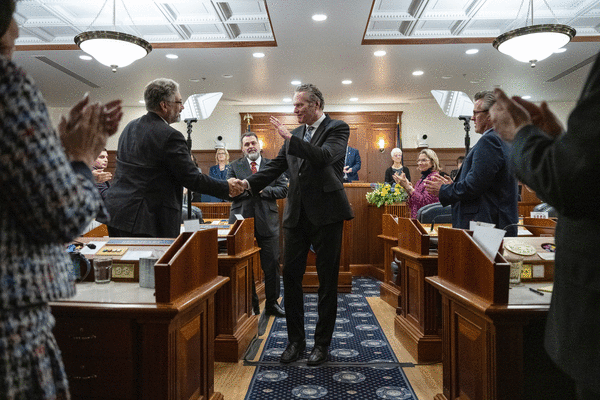
JUNEAU, Alaska — Gov. Mike Dunleavy delivered his eighth and final State of the State address Thursday, spending more than half of the 80-minute speech touting an extensive list of what he said were the top accomplishments of his seven years as governor.
“Despite what some in the media would like to portray, despite what some bloggers might want to say, and some special interests and political opponents like to convey, some really great things for Alaska have happened under my administration,” said Dunleavy.
The governor for months has promised to propose during his last year in office a fiscal plan that will include new taxes amid unstable oil revenue. He again reiterated his intention to introduce such a plan during the Thursday speech, but provided only a vague outline of what it would include and no specifics on the taxes it will encompass.
Dunleavy said earlier in the week that his plan includes a new sales tax, but the sales tax was not mentioned in his address.
“In my last year, I am going to once again make a concerted effort, by introducing what I believe is a fiscal package — a package that will not only work, but will solve this issue for many, many years to come,” said Dunleavy.
Majority lawmakers met the governor’s speech, and in particular his promise to solve the state’s fiscal crisis in his final year in office, with some skepticism.
“Is he going to put out revenue measures? We haven’t seen them,” said Rep. Louise Stutes, a Kodiak Republican who caucuses with the bipartisan House majority, after the speech concluded. “We haven’t even had a conversation with him about these revenue measures.”
Dunleavy said his fiscal plan will also include new limits on state spending. Alaska already has statutory and constitutional spending limits, but it does not currently have enough revenue available to reach those spending limits without drawing from savings.
“No new revenue source can be enacted without corresponding fiscal restraint,” Dunleavy said.
The governor urged lawmakers to take his fiscal plan seriously during the four-month legislative session.
Legislative leaders said that passing a plan like the one envisioned by the governor would take two to three years, not four months. Such a plan would be a particularly heavy lift in an election year, they said.
“I’m not optimistic for a fiscal plan this year,” said House Speaker Bryce Edgmon, a Dillingham independent.
Dunleavy painted a largely positive picture of the state during his speech, listing reductions in crime and expansion of resource development among improvements during his tenure.
Leaders in the majorities said many of the accomplishments listed by Dunleavy were possible only thanks to his work with the Legislature, illustrating the need for better collaboration between the separate branches of government.
“It underscored the fact that this is teamwork. It takes the Legislature and it takes the executive branch,” said Sen. Cathy Giessel, an Anchorage Republican.
But in the governor’s speech, he was largely dismissive of lawmakers’ calls for closer collaboration, saying he was “not a 61st legislator.”
Dunleavy extolled President Donald Trump’s embrace of Alaska’s resource development industry and said his “positive relationship” with Trump was key in securing for Alaska tens of millions of dollars in federal highway funding, promoting the Alaska natural gas pipeline, advancing new mines, and securing hundreds of millions in funding for Alaska’s rural health care services.
Dunleavy dedicated the latter part of his speech to a series of policies he said his administration would work on in its final months, including ones to improve housing supply and reduce crime.
Dunleavy said his Department of Law and the Municipality of Anchorage would begin partnering to “drive down crime,” which remains far above the national average. The first phase of the partnership would focus on retail theft, public camping, drug activity and disorderly behavior, he said.
The governor also said he would introduce an initiative involving his administration and the Alaska Housing Finance Corp. to provide buildable land and competitive mortgage rates, and lower down payments. Municipalities participating in the program would provide long-term tax breaks for first-time buyers, he said.
“It’s a win-win-win for the state, our communities and, most importantly, our young people,” he said.
Sen. Bert Stedman, a Sitka Republican, said the plan could be “very helpful to most of the cities around the state.”
Among Dunleavy’s guests in the legislative gallery were Brendan Duval and Adam Prestidge, the chief executive and president of Glenfarne, a private energy developer that has taken over planning of a long-envisioned natural gas pipeline in Alaska.
Dunleavy showered the company with praise, hours after Glenfarne announced it had signed new agreements to advance the pipeline. The governor’s speech did not include new specifics on the project’s cost or the timing of a final investment decision.
Still, Dunleavy said there is “no shortage of good news about this project.” Alaska LNG is “a dream realized, a hope fulfilled” that will “keep our young people in this state and attract others Outside,” Dunleavy said.
Dunleavy again indicated he would ask lawmakers to approve tax breaks to help it advance.
The governor concluded his address with a call on lawmakers to embrace “new ideas,” including on artificial intelligence and robotics.
“Let’s not be afraid of what the future may bring,” he said. “Let’s take advantage of the opportunities instead.”
At the end of the lengthy speech, lawmakers appeared ready for a busy session of considering the governor’s priorities while also focusing on ones that the governor made no mention of — like helping the state’s ailing commercial fishing industry.
“Obviously, there’s a lot to accomplish in the next few weeks — few days, honestly,” said Senate President Gary Stevens, a Kodiak Republican. “There’s a tremendous amount of things he said he wants us to get through. We have to do things properly and slowly and rightly and correctly, and everything does take more time than you think.”
_____
©2026 Anchorage Daily News. Visit at adn.com. Distributed by Tribune Content Agency, LLC.





Comments