Jury acquits Chicago man accused of soliciting murder of Border Patrol Cmdr. Gregory Bovino
Published in News & Features
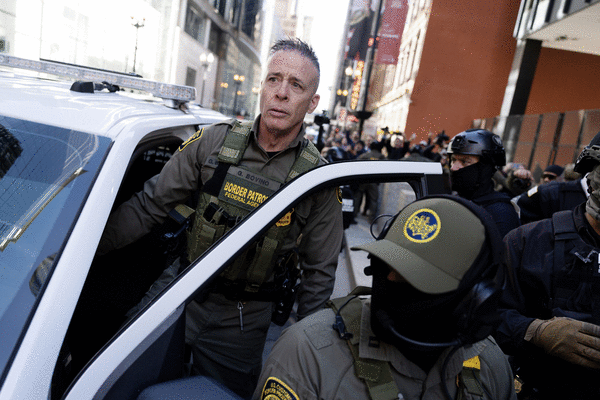
CHICAGO — A federal jury on Thursday found a Chicago construction worker not guilty of charges he solicited the murder of Border Patrol Cmdr. Gregory Bovino, delivering a swift repudiation in a case the Trump administration had held up as evidence of violence toward immigration officials.
After a lightning-fast trial, the jury of six men and six women deliberated for about three hours before acquitting Juan Espinoza Martinez of the one count of murder for hire that he faced.
Dressed in a gray suit and tie, Espinoza Martinez, 37, had no immediate reaction in court, while his brother a few yards away made the sign of the cross and pumped his fist.
Espinoza Martinez, who has been locked up at the Metropolitan Correctional Center since his arrest on Oct. 6, could have faced up to 10 years in prison if convicted. Despite the not guilty verdict, however, he will likely not go free, since he’s been living in U.S. illegally and there is an ICE detainer out for him.
Regardless, the verdict is a stinging rebuke in what was the first criminal case stemming from Operation Midway Blitz to go to trial — one that seemed to get weaker for the prosecution at almost every step of the proceedings.
When he was first arrested in early October, Espinoza Martinez was labeled by the Department of Homeland Security as a high-ranking member of the Latin Kings street gang, someone who had the power to pay other gang members to commit murder of a top government official.
But those claims, repeated incessantly by Department of Homeland Security Secretary Kristi Noem and other top Trump administration officials, dissolved in court, where no evidence was ever brought forth that he was in a gang, let alone a ranking member.
In fact, Espinoza Martinez, a married father of three, had a steady job, no gang tattoos, and no criminal history whatsoever.
By the time the case went before the jury, prosecutors were forced to abandon any argument that Espinoza Martinez had ties to the gang, though the jury did see passing references he made in text messages to “LK” and their opposition to the ongoing immigration enforcement in Little Village.
Meanwhile, the Tribune reported the top prosecutor on the case abruptly resigned from the U.S. attorney’s office earlier this month for unexplained reasons.
In closing arguments before U.S. District Judge Joan Lefkow, prosecutors said Espinoza Martinez was angry about immigration raids in his neighborhood and “fixated” on Bovino when he sent out a message soliciting Bovino’s murder.
It was more than just a protest, more than a mere call to action. It was a call for violence, First Assistant U.S. Attorney Jason Yonan said in his closing argument in Espinoza Martinez’s murder-for-hire trial.
“He crossed the line,” Yonan said.
But in her closing remarks to jurors, defense attorney Dena Singer said prosecutors had no evidence of Espinoza Martinez’s intent when he sent the messages, which said a Chicago street gang was willing to pay $2,000 for Bovino’s kidnapping and $10,000 for his killing.
“The government wants you to convict him on murder for hire based on Snapchat messages sent to a physically challenged friend and his own brother. ... That’s it, that’s their entire case,” Singer said.
Singer called the Snapchat messages nothing more than repeating online gossip, “sent to two people who had no intent to take action who couldn’t take action.”
Espinoza Martinez, like many people living through Operation Midway Blitz in the Little Village neighborhood, took screenshots and shared information about ICE’s whereabouts and specifically about Bovino, the controversial face of the deportation effort.
“Being upset about ICE raids, about people being deported, being upset about that is not murder-for-hire,” Singer said.
She ended her remarks by urging the jury to “stop the overreaching government.”
“Don’t let them bully you. Use your voice,” she said. “While the government and the agents didn’t want to listen to Juan’s voice, they will listen to yours.”
Closing arguments got underway Thursday after less than a day of evidence. Jurors are expected to begin deliberating shortly after lunch.
Espinoza Martínez’s trial is the first criminal case to stem from Operation Midway Blitz to go to trial and has garnered national headlines since it was first charged, with Trump administration officials holding it up as an example of the threats and violence faced by immigration officials during their deportation push.
Though limited in scope, the case is an important litmus test as immigration-enforcement operations continue to roil Chicago and other Democrat-led cities long targeted by President Donald Trump, including Minneapolis, where the killing of a U.S. citizen by an immigration agent earlier this month has sparked nationwide protests.
When the charges were first brought, authorities accused Espinoza Martínez of being a high-ranking member of the Latin Kings. But evidence of any gang membership never materialized, and much of the testimony about the Latin Kings wound up being toned down or stripped from the trial completely.
In his rebuttal argument Thursday, Assistant U.S. Attorney Minje Shin told the jury that whether Espinoza Martinez was a Latin King or not “doesn’t matter.”
“You don’t have to be a member of the Latin Kings” to be guilty of solicitating a murder,” he said. “… If you play a role in that actively, because you’re seeking an outcome you also want, you are making it your own.”
According to prosecutors, Espinoza Martínez sent Snapchat messages to an acquaintance from the construction business, Adrian Jiménez, calling for Bovino’s killing after an immigration agent shot a woman in Chicago’s Brighton Park neighborhood on Oct. 4.
Jiménez, who had worked as a government informant on and off for years, shared the messages with Homeland Security Investigations, including one that had a screenshot of a Chicago Tribune photo of Bovino with the words, “2k on information when you get him” and “10k if u take him down.”
In his closing argument Thursday, Yonan showed the jury the Snapchat message with Bovino’s photo, asking them why Espinoza Martinez would include it if he didn’t know exactly what he was asking.
“So that it’s absolutely crystal clear who is the subject, who is the person who needs to be killed … there is no other reason to do it. That shows his intent,” Yonan said.
Yonan called Espinoza Martinez a “Jekyll and Hyde” persona. “He was angry. He didn’t like what was going on in his neighborhood and he was fixated and obsessed with Gregory Bovino.”
When Jimenez asked Espinoza Martinez what he meant in his text about the alleged bounty, Espinoza Martinez’s explanation was telling, Yonan said.
“If the response (from the defendant) is anything other than ‘this is a joke, I’m not serious, Oh I was just passing this along … that shows his intent,” Yonan told the jury.
Singer, however, played clips from the videotaped interview Espinoza Martinez had with agents on the day of his arrest. In the interview, Espinoza Martinez repeatedly denied that his messages were any call for violence against Bovino.
“This was their evidence! They put these statements in. So you can’t just ignore it,” Singer said, noting that “Over 30 times, in different ways, Juan says ‘I didn’t intend that.'”
Jiménez testified Wednesday he first met Espinoza Martínez about a year ago after he reached out to him on Snapchat, looking for construction work.
Jiménez testified he had conversations about immigration with Espinoza Martínez “more than a few times.” But when Shin attempted to ask what they talked about specifically, the defense repeatedly objected and the judge sustained it.
Jiménez testified he took Bovino-related photos of the Snapchat messages received from Espinoza Martínez on Oct. 2 and “almost immediately” contacted agents with HSI about them.
Shortly after his arrest on Oct. 6, Espinoza Martínez was led by three federal agents into a windowless interview room, still dressed in a green work T-shirt and carrying a small bottle of water.
In portions of the ensuing videotaped interview played for the jury on Wednesday, the agents pressed Espinoza Martínez repeatedly on how he thought his text messages looked, including references to the Latin Kings street gang backing the offer.
He said over and over he meant nothing by it, that they were nothing more than social media chatter, and that he had no intention of making any actual offer for Bovino’s killing.
“I’m really confused about this,” Espinoza Martínez said at one point. “I’m not nowhere around there. I work for a living every day. I’m a union worker. I work concrete, so I don’t know.”
After prosecutors rested, the defense called as its only witness Oscar Espinoza, the defendant’s younger brother, who testified he’d already seen the language about a Bovino bounty on Facebook an hour or so before his brother sent it to him.
“I took it as a joke,” the brother testified.
In his final argument, Shin pushed back at the idea that Jimenez’s health issues, which included a bad back causing him to limp into court on Wednesday, made Espinoza Martinez’s solicitation any less chilling.
Not only did Espinoza Martinez know and trust Jimenez, he knew Jimenez had done prison time and was “connected,” having formed his own construction business last year.
“What better person to provide this information?” Shin asked. “(Jimenez’s) role in the scheme was to discreetly broadcast the information to people he thought could be trusted.”
____
©2026 Chicago Tribune. Visit at chicagotribune.com. Distributed by Tribune Content Agency, LLC.





Comments