Judge rebuffs push for independent monitor after DOJ blows Epstein files deadlines
Published in News & Features
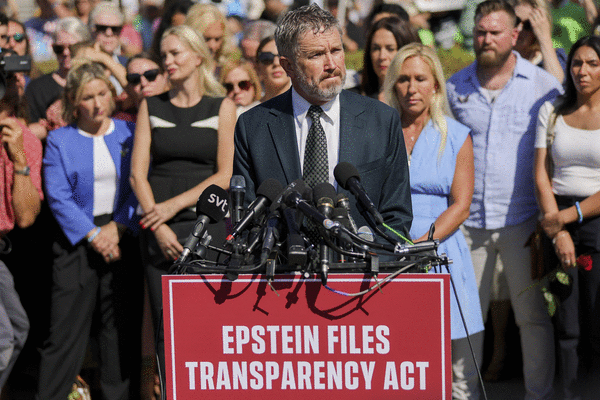
A New York federal judge has denied a request from members of Congress and victims of Jeffrey Epstein for an independent monitor to oversee the Department of Justice’s release of its investigative files into the late sex trafficker.
California Democratic Congressman Ro Khanna and Kentucky Republican Congressman Thomas Massie sent the request to the New York District Court earlier this month for the “appointment of a Special Master and Independent Monitor” over the Justice Department after the department blew past multiple disclosure deadlines required by a new law.
They filed their request within the ongoing criminal proceedings into Epstein’s longtime partner Ghislaine Maxwell, who was convicted of sex trafficking a minor in 2021.
Judge Paul Engelmayer ruled that the federal criminal case into Maxwell does not give him the jurisdiction to “supervise” the Justice Department’s compliance with a civil records law.” He did, however, suggest wrongdoing by the DOJ.
“The questions raised by the Representatives and the victims are undeniably important and timely. They raise legitimate concerns about whether DOJ is faithfully complying with federal law,” he wrote in his ruling Wednesday.
The Justice Department was supposed to release its Epstein files by Dec. 19 in response to a new law called the Epstein Files Transparency Act. But the department has only released a tiny percentage of the potentially relevant files to date, Attorney General Pam Bondi told the court earlier this month. The DOJ also failed to meet an additional deadline in the law to explain all of its redactions to the files to Congress, Khanna and Massie told the court.
The decision comes after weeks of pleas from members of Congress and victims, and repeated justifications from Bondi for the ongoing delays and missed deadlines.
In statements to the Miami Herald, Khanna said he will continue to pursue “every legal option” and Massie said he will force compliance “using other avenues available.”
How we got here
On Jan. 8, Khanna and Massie sent their letter to the judge outlining the Justice Department’s failure to meet the deadline set by the law and requesting the independent monitor. They also accused the department of overstating the number of records to justify blowing past the legally mandated Dec. 19 deadline to release all of its files.
The Justice Department announced after that deadline that it had “uncovered” more than a million additional documents. Bondi also told a judge in early January that the department had released fewer than 1% of the potentially relevant documents — about 12,000 out of more than 2 million.
“There is reasonable suspicion that the DOJ has overstated the scope of responsive materials, thereby portraying compliance as unmanageable and effectively delaying disclosure,” Khanna and Massie wrote to the judge.
The Justice Department has repeatedly told the judge that their ongoing delays in releasing the files are due to their efforts to fully protect victim-identifying information — which victims’ advocates have accused them of failing to do in the release of the first 12,000 records.
Epstein victims lawyer Spencer Kuvin called that justification a total fabrication in a phone call with the Herald.
“They haven’t talked to the victims. Some victims want to be protected, others don’t,” Kuvin said. “They’re acting in a paternalistic way assuming that all victims are a homogenous group, which they’re not.”
He thinks the best solution to force the release of the files is for Congress to go back and amend the law to add a clear enforcement mechanism and allow victims to sue the Justice Department over their failure to comply.
Two victims also argued to the New York federal court this month that the DOJ has lost all credibility with them, and said they have little faith in the institution to protect them or comply with the law.
“The Department of Justice’s continued failure to comply with its statutory obligations has caused significant emotional distress and retraumatization, both to me and to other survivors with whom I regularly speak,” wrote Lisa Phillips, a self-identified survivor of Epstein and Maxwell.
She asked him to grant Khanna and Massie’s request for an independent monitor.
“As survivors, this failure is not merely procedural — it is deeply personal,” Haley Robson wrote to the court, also calling for an independent monitor. “Continued noncompliance perpetuates the same secrecy that allowed these crimes to continue unchecked for years.”
She criticized the Justice Department’s failure to release victim interview statements and the “53-page draft indictment and an 82-page prosecution memorandum prepared during the 2007 Florida investigation” ahead of Epstein’s controversial immunity deal, as the Herald documented in its 2018 "Perversion of Justice" investigation.
In her plea to the court for an independent monitor, Robson wrote, “Each survivor has already paid a tremendous price. Coming forward has required extraordinary courage, exposing ourselves to public scrutiny, retaliation, and lifelong emotional consequences.”
She added: “We did so with belief in our government and trusting that when Congress passed this law, the Executive Branch would honor it. Instead, we are met with continued delay, silence, and ongoing protection of identities that should no longer remain hidden.”
©2026 Miami Herald. Visit at miamiherald.com. Distributed by Tribune Content Agency, LLC.





Comments