For decades many have predicted the downfall of Cuba's regime. Is this time different?
Published in News & Features
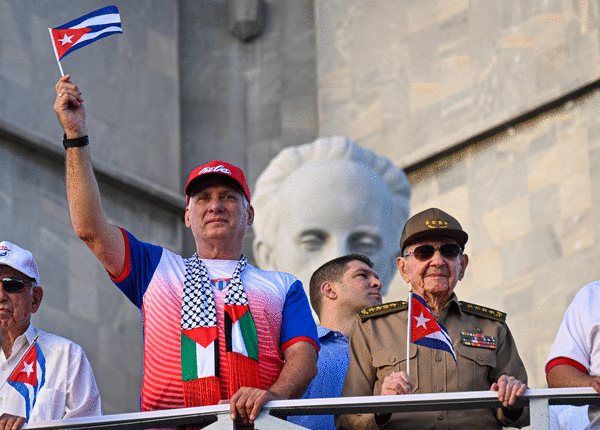
Following the capture of Venezuelan strongman Nicolás Maduro in an operation in which several Cuban security officers died protecting him, Donald Trump joined a long line of U.S. presidents who over the decades anticipated the collapse of Cuba’s communist government.
“Cuba gives protection to Venezuela, and Venezuela gives Cuba money through oil — and it’s been that way for a long time — but it doesn’t work that way anymore, so I don’t know what Cuba’s going to do,” Trump told Fox News. “I think Cuba’s going to fail. I don’t think there are alternatives for Cuba.”
Trump warned Cuban leaders to “make a deal before it’s too late.” He then said his administration was already in talks with Cuban authorities, a claim the island’s handpicked president, Miguel Díaz-Canel, promptly denied.
In Miami last week, the head of the U.S. Embassy in Havana, Mike Hammer, told reporters not to pay attention to Havana’s denial, but declined to comment on any negotiations. The pressure on the Cuban government “is intensifying,” he said. “What is happening is creating an opportunity, and of course, we want to be able to have the Cuban people benefit from this opportunity.”
Can Trump succeed where others have failed?
The Trump factor
There are several elements that make this moment distinct from other crises the Cuban leadership has weathered over the years.
On the U.S. side, there’s Trump’s unpredictability and his willingness to use military force to achieve foreign policy goals, as the raid to capture Maduro showed.
“I think that’s what the Cubans now learned, that Trump is like no president we’ve had since 1959, so everything they thought they knew is out the window,” said Chris Simmons, a former U.S. counterintelligence official who has helped identify Cuban spies operating in the United States.
“That’s got to make them very nervous,’ added Simmons, who also mentioned the role of Secretary of State Marco Rubio, a Cuba hardliner. “When you’ve got Rubio talking about they may be next, they’re going to take that very seriously. I mean, they’d be fools not to.”
Trump said that ousting the regime in Havana might take military action, though he has ruled that out for the moment.
“I don’t think we can have much more pressure other than going in and blasting the hell out of the place,” he told conservative radio host Hugh Hewitt. “I think that Cuba is really in a lot of trouble. But you know, people have been saying that for many years.”
At the same time, Trump’s transactional style and tendency to view international conflicts as opportunities for deal-making might help kickstart a negotiated transition — if Cuban leaders take the off-ramp.
“We are talking to Cuba, and you’ll find out pretty soon,” he said. “One of the groups I want taken care of is the people who came from Cuba who were forced out or left under duress, and they are great citizens of the United States right now.”
Cuba watchers say perhaps Trump is talking about negotiating compensation for Cuban Americans who were forced to flee the island and lost their properties after Fidel Castro took power in 1959. But many other issues could be discussed, including the repatriation of Cubans, allowing private investment and the lifting of some sanctions, said Joe García, a former Democratic member of Congress who has advocated for negotiations with Havana and the release of political prisoners.
After years of dragging its feet on reforms, the Cuban government may not have much time left to act, Hugo Cancio, a Cuban American businessman who owns an online supermarket that delivers food on the island, told the Miami Herald.
“In light of recent developments in Venezuela, Cuba today faces a clearer choice than ever: to open itself in a gradual and credible manner to economic reform, institutional modernization, and broader civic participation, with the constructive engagement of its diaspora, or to continue down a path of managed decline,” Cancio said. “The real risk is not change; the real risk is postponing it until the cost becomes irreversible.”
The Cuba Study Group, an influential Cuban-American organization that has focused on supporting the island’s private sector, also urged the Cuban government to engage in talks with the U.S.
“Today, no external power will bail the island out,” the group said in a statement. “Old formulas will not avert catastrophe. To prevent greater disaster, Cuban authorities must take steps they have never taken before,” including a wide political dialogue that includes the Cuban diaspora.
The group advised Cuban leaders to “propose a bold restructuring that advances the rule of law, democratic norms, and a market economy while preserving a social safety net. And they should make unmistakable gestures—such as unconditionally freeing political prisoners—that demonstrate genuine commitment to turning the page.”
The Rubio factor
In the past, many Cuban exiles and Cuban American hardliners have strongly opposed negotiations with the Cuban government. But this time, they are likely to back up president Trump’s efforts, largely because Rubio, a Cuban American from Miami, is the one steering U.S. policy on Cuba.
“Marco Rubio is the most trustworthy representative the exile community has had in 67 years,” said Marcel Felipe, the chairman of the American Museum of the Cuban Diaspora and a Miami Dade College trustee. He said he trusted Rubio to get the best possible outcome in negotiations to push for regime change in Cuba, one that Cuban exiles could live with.
García, the former congressman, said that even though he is a Democrat and Rubio is a Republican, “Marco represents me and many Cubans who want to see change in Cuba.”
State Department officials have been reaching out to members of the Cuban American community for their input about how a transition in Cuba would look like.
“The Cuban exile community has been preparing for this for a long time,” said Felipe, who’s also the chairman of Inspire America, a pro-democracy organization. He said his organization and others have been sharing plans with U.S. officials for “day one” and the country’s reconstruction.
Trump has also commented on the role Cuban Americans will likely play in economically rebuilding Cuba.
“You have a lot of people in this country that want to go back to Cuba and help Cuba,” he said in a meeting last week with the CEOs of several oil companies to discuss investments in Venezuela. “They didn’t have anything, and they became very rich people in our country, and they want to very much go back and help Cuba. That’s something that Cuba has that a lot of other places don’t have.”
The Cuban economy factor
In Cuba, “a Revolution running on empty is finally out of gas,” the Cuba Study Group said.
For decades, Fidel Castro ruled Cubans with a combination of repression, propaganda and populism. Many Cubans still fear opposing the government, but ideological support has eroded, and the state can no longer meet the most basic needs of the population.
The new chapter of confrontation with the United States finds the island at its worst time economically, already on the verge of collapse.
Cuba’s GDP fell another 5% last year, after several years of recession. A botched monetary reform has triggered skyrocketing inflation. The electrical grid collapses regularly, leaving the entire country in the dark. Oil shortages and obsolete power stations constantly breaking down have made daily hours-long blackouts the new normal. Garbage covers streets in the capital, fueling mosquito-borne diseases. Old buildings in Havana frequently collapse after years of neglect.
A sociologist living on the island, Mayra Espina, estimates that more than 40% of the population lives in poverty, a figure that could actually be much higher, over 80%, according to surveys done by the Cuban Observatory of Human Rights, a Spain-based organization.
Unlike the times Fidel Castro maneuvered his way out of crises, Cuba’s current leadership has proved less skillful, more prone to inaction, and notoriously less popular than the late Cuban dictator. A frail Raúl Castro reappeared Thursday to pay homage to the 32 Cuban officers who died during the U.S. raid to capture Maduro. He is the country’s ultimate authority, but he is 94, and behind the scenes power struggles for succession are already likely taking place.
For the time being, Cuban leaders appeared unified and defiant in public. On Friday, Díaz-Canel rejected Trump’s deal offer.
“There is no possibility of surrender or capitulation, nor any kind of understanding based on coercion or intimidation,” he said before shouting Castro’s old slogan, “Patria o Muerte,” Fatherland or Death, during a massive protest rally in Havana organized by the government to show it has broad support.
“Cuba does not have to make any political concessions, and this will never be on the table in negotiations for an understanding between Cuba and the United States,” Díaz-Canel added.
Cuban state media has shown images of military exercises that purport to convey a sense of readiness against a U.S. military attack. The images, however, highlight the vast gulf between the United States’ advanced military armament and Cuba’s old Soviet technology.
Beyond the rhetoric, however, mid-level Cuban officials, economic advisers, academics and others who interact with foreigners share many of the population’s frustration with Díaz-Canel’s leadership and would welcome reforms, Herald sources who travel to Cuba and asked for anonymity to describe their interactions said.
“Ten years ago, you would hear Cuban officials defending Marxism. Now they tell you stuff about Díaz-Canel that makes me look around to see if anyone is listening. They are ready for change,” one of the sources said.
A conspicuous sign of the erosion of support for the Cuban socialist system: Several children and close relatives of former and current Cuban officials, as well as members of the Castro family, live abroad, including Díaz-Canel’s stepson and three grandchildren of Fidel Castro, who live in Spain.
Even Interior Minister Humberto Alfonso Roca Sánchez, who Díaz-Canel said was the one in charge of the Cubans who died protecting Maduro, has two daughters who live in the United States, according to the U.S. government outlet Martí Noticias.
Socialist policies and government repression are behind the largest cumulative exodus in Cuban history. An estimated 2.5 million Cubans left the country between 2021 and 2024, almost a quarter of the island’s population, according to estimates by Juan C. Albizu-Campos, a Cuban economist and demographer, at a conference in Miami of the Association for the Study of the Cuban Economy in October.
The discontent extends even among Interior Ministry officers who guard Cuban prisons, says José Daniel Ferrer, a former political prisoner and prominent dissident who now lives in exile in Miami. He said some of the guards would mention to him privately they face the same scarcities as the population.
Despite new harsh laws to punish dissent, many Cubans have voiced criticism of the government in public, on social media and in comments left on Cuban state news websites. Asked by a reporter from Cubanet, a Miami-based outlet, what would happen if U.S. forces captured Díaz-Canel, some residents in Havana declined to answer, but others were surprisingly candid.
“How happy that would make me. Get them all the f—k out of here, to see if we can be happy, to see if we can see the fruit of our work,” a man answered.
Obstacles in the way
However different Cuba’s currently economic and political scenario is, any regime change efforts by the Trump administration will face an old dilemma, experts say: Calibrating how much pressure to put on a country that is just 90 miles from the United States and has a sizable amount of its population and their descendants living in South Florida.
Rubio has long been laser-focused on targeting the Cuban military, and the administration is likely to ratchet up pressure on GAESA, the armed forces’ conglomerate that controls at least 40% of the country’s economy. GAESA had been redirecting the country’s foreign revenue into hotels and had $18 billion stashed away last year, while the population faces deprivation, the Herald previously reported.
At the same time, Rubio has spoken carefully, telling the Cuban government it has a choice to make and stressing the administration has no interest in a destabilized Cuba.
“If you put too much pressure on Cuba and really turn the screws on it, you’ve got the makings of a Spanish-speaking Haiti,” said John Kavulich, a longtime Cuba watcher and president of the U.S.-Cuba Trade and Economic Council that tracks trade with Cuba. He believes Rubio will push back against demands by some Cuban American lawmakers to exert maximum economic pressure, “because he’s going to be thinking about the day after, what does this look like?”
The Trump administration has significant leverage, as economists predict the end of Venezuelan oil subsidies could have devastating consequences for the island.
Jorge Piñón, a senior research fellow at the Energy Center at the University of Texas who closely tracks oil shipments to the island, said he did not believe Mexico or Russia will step up to fill the gap left by the halt of Venezuelan oil, which he said covered around 50% of Cuba’s oil import needs.
Still, it is uncertain whether economic pressure alone would make Cuba “fail” on its own, as Trump has predicted.
“It’s not failing on its own; its failure being hastened,” said Kavulich. “But we have seen this movie before. Does this mean that the government of Cuba will collapse? I think not.”
Kavulich believes Cuban leaders will try to make concessions to the Trump administration in order to survive, not unlike what the remaining members of the Maduro regime are currently doing in Venezuela.
“They will start looking in the survival manual and say, okay, what’s the first thing we can do?,” he said. “ We can release political prisoners. What’s the second thing we can do? We can further open up the economy. That’s their playbook. It’s not going to be, ‘we’re going to hold free and fair elections,’ but it’s going to be, ‘what can we do to forestall doing stuff that we really don’t want to do?’”
“The unknown is how much pressure the Trump administration wants to exert,” Kavulich said.
Who is Cuba’s Delcy Rodríguez?
Central to the Trump administration’s efforts to negotiate a future transition with Havana, experts say, is finding Cuba’s equivalent to Delcy Rodríguez, Maduro’s vice-president who is now leading an interim government and has so far conceded to key Trump demands.
Power in Cuba is more fragmented than under Fidel Castro’s rule. His brother, Raul, is not in charge of day-to-day decisions. His handpicked successor, Díaz-Canel, is seen as a figurehead atop a civilian government that has little real power, even if he is officially the first secretary of the Communist Party. Few believe he could be the lead negotiator with the Americans.
Real power lies with the military. The generals have seats at the National Assembly, the Party, and the government’s top decision-making bodies. The country’s prime Minister Manuel Marrero, also comes from the military.
Members of the Castro family remain influential. That includes Raúl Castro’s son, Col. Alejandro Castro Espín, who negotiated with U.S. officials during the Obama administration, and grandson Raúl Guillermo Rodríguez Castro, who is in charge of Raúl’s personal security and is involved in GAESA’s obscure finances. In less than two years, another family member, Oscar Pérez-Oliva Fraga, a grandnephew of Fidel and Raúl Castro, has been climbing the ladder to become minister of foreign trade and investment and vice prime minister.
Would any of these players be enticed to negotiate to avoid ending like the Venezuelan strongman?
“Part of the message that I think the administration is hoping for is, look what happened to Maduro,” said Ryan Berg, director of the Americas Program of the Center for Strategic and International Studies in Washington. “He was given options to leave peacefully. He wouldn’t have been in an orange jumpsuit now, but he is because he didn’t take the offer to go to Turkey or Qatar. And that’s a lot of leverage. But given the ideological factor in Cuba, I’m a little bit skeptical that they would take the off-ramp. I think many of them would go down with the ship rather than take a negotiated exile”.
Pinpointing precisely who might be Cuba’s reformer who would be willing to work with the United States to dismantle the communist system and rebuild the country has proved elusive.
“I don’t think that there’s really an analogy here with Venezuela,” Berg said. “Whether you agree with this theory or not, we have identified Delcy Rodríguez as the one who could take over and implement pragmatic policies that are pro U.S. What is the analogue in Cuba’s case?”
An unsavory answer
The answer to that question right now might be unsavory for Rubio and Cuban exiles, said Ric Herrero, the executive director of the Cuba Study Group.
“The only person that’s a Delcy-type in Cuba now is Raúl Castro,” he said. “Because what is Delcy? Delcy is someone from within, a senior official. She was a vice president, but who has significant clout within the party, within the bureaucracy and with the military. Someone who can keep all of those sectors in line and all the different factions playing ball.”
“Who can achieve that in Cuba without having the last name Castro?” he asked.
Felipe said it would be “extremely difficult, if not impossible, for the Cuban exile community to accept a transition model that involves someone whose last name is Castro.”
Many longtime Cuban activists who have fiercely opposed negotiations with the regime in Havana might end up disappointed if what the administration is doing in Venezuela serves as an example of how it might operate with Cuba. The Helms-Burton Act Congress passed in 1996 forbids recognizing a transitional government led by Raúl Castro but doesn’t say anything about other members of his family.
Cuban opposition members would not favor a negotiation with Raúl Castro or another member of the Castro family, said Ferrer the former political prisoner.
“But if we are pragmatic and one of them negotiates, and Trump and Rubio manage to get the transition to democracy moving as quickly as possible, then that’s better than continuing in the situation we’re in, in complete stagnation, with the people still suffering from hunger, hardship, and extreme poverty, and above all, remaining without rights, without freedom, and constantly repressed, with the prisons full of political prisoners,” Ferrer said.
“Ideally, this process would be completed as soon as possible, and the Castros would disappear from power because of all the harm they have done to Cuba,” he added.
Part of the reason the regime in Havana has been able to survive so long is that, unlike Venezuela, where several opposition parties are still legal, Fidel Castro abolished all opposition parties and dissidents like Ferrer are routinely sent to prison or exile.
Even so, the Trump administration decided to work with Rodriguez instead of María Corina Machado, the leader of the Venezuelan opposition, to manage a transition, Ferrer noted.
“We are insisting with our American friends that the Cuban opposition, both the internal opposition and the organized exile community that has been fighting for years for a transition to democracy in Cuba, cannot be ignored at any time,” Ferrer said. “We must be an active part of any process. We cannot be marginalized.”
Ultimately, there is one reality that has not changed in several decades in Cuba: the regime in Havana still keeps much of its capacity for repression, has all the guns, and tens of thousands of security and military personnel to squash dissent and instill fear. Protesting often lands people in prison.
On Friday, Cuban independent journalist José Gabriel Barrenechea Chávez was sentenced to six years in prison for participating in a peaceful protest banging pots during a blackout in Villa Clara, a province in central Cuba.
But as the economy collapses and discontent grows among Cubans, increasing U.S. pressure and the regime’s inability to address the population’s pressing needs may well trigger another chapter of mass protests, similar to those in July 2021, Ferrer said.
The regime in Havana, he bet, “won’t make it to the end of the year.”
_____
©2026 Miami Herald. Visit miamiherald.com. Distributed by Tribune Content Agency, LLC.



Comments