Poll: Majority of Venezuelans thank Trump, but don't believe he runs their country
Published in News & Features
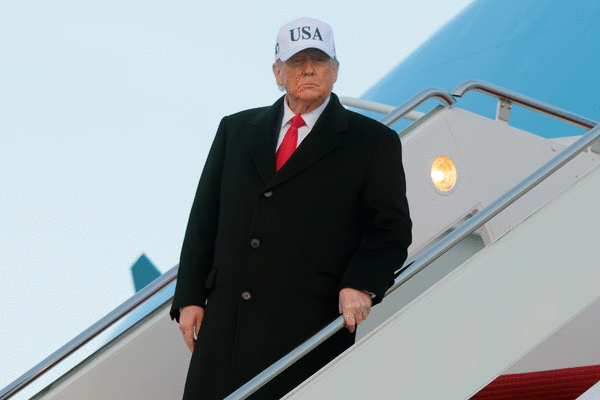
An overwhelming majority of Venezuelans say they are deeply grateful to President Donald Trump for ordering U.S. troops into the country to capture strongman Nicolás Maduro — but even after that dramatic action, most do not believe the U.S. now governs Venezuela, despite Trump’s repeated assertions that Washington holds the real power in Caracas.
That tension — gratitude without illusion — defines the political mood captured in a new nationwide survey conducted in early January, according to Rubén Chirinos, president of the Venezuelan polling firm Meganálisis.
“This is a country that feels hope, but also fear,” Chirinos said in an interview discussing the findings. “People recognize that Chavismo is fragile, but fear has not disappeared. And as long as fear exists, control belongs to whoever generates that fear.”
Polling under fear — and silence
The Meganálisis CATI survey, conducted Jan. 6–11 among 1,006 Venezuelans, is the firm’s first poll published since July, after nearly six months of silence. Chirinos said the decision to release the data now was deliberate.
“We can no longer remain silent and hide,” he said. “The truth is out there, and it must be told.”
Conducting the survey was unusually difficult. Meganálisis had to make more than 15,000 phone call attempts to secure just over 1,000 valid responses — nearly double the number required in earlier periods.
“This gives you an idea of the climate,” Chirinos said. “There is a sense of government fragility after recent events, which made some people slightly more willing to respond. But fear of persecution and detention is still very much present.”
That fear remains the survey’s most consistent finding: 84% of respondents say they believe they could be arrested if they publicly demonstrate or express opposition to the regime. Nearly 87% believe political prisoners and political persecution exist, and among them, 98% say all political prisoners should be released — roughly 85% of the total sample.
“People answer surveys because they’re anonymous,” Chirinos said. “But in real life — posting on WhatsApp, speaking openly in a restaurant — that’s still dangerous.”
Gratitude and skepticism about U.S. control
The survey shows overwhelming appreciation for Trump’s actions. More than 92% of respondents say they feel grateful to Trump, and 90.6% view the United States as Venezuela’s best ally.
Chirinos said the result did not surprise him.
“The rejection of Chavismo was already extremely high,” he said. “And when you add the events of Jan. 3, plus announcements of investment, prosperity and the return of Venezuelans living abroad, gratitude toward Trump grows even stronger.”
Yet that gratitude does not translate into a belief that the United States now governs Venezuela. Nearly 68.4% say Washington does not truly control the country, and 52.7% believe U.S. priorities are driven more by oil than by human rights.
“There’s a sense that the job is not finished,” Chirinos said. “As long as people are afraid to express themselves, the supposed control of the United States is questionable.”
He pointed to mixed signals coming from Washington — such as meetings with oil companies followed by continued travel bans to Venezuela — as factors fueling public uncertainty.
“If there’s going to be investment, why can’t people travel?” he asked. “That contradiction creates confusion.”
Maduro and his wife, Cilia Flores, were captured on Jan. 3 in a pre-dawn raid conducted by U.S. forces in Caracas, during which key military and regime installations were bombed, leaving more than 100 people dead, according to regime sources. Maduro and Flores were taken to New York, where they now face federal drug trafficking charges.
Since then, Trump and Secretary of State Marco Rubio have repeatedly said that Washington is now calling the shots in Venezuela.
Interim President Delcy Rodríguez now faces the difficult task of executing a White House–backed plan to stabilize Venezuela and steer it toward a more U.S.-friendly political order — without provoking the regime’s radical base.
Regime still feared, but stripped of legitimacy
While 67% of respondents say Chavismo still governs Venezuela, the poll shows the movement has lost virtually all political credibility.
More than 90% of respondents said they do not trust any of the regime’s top figures, including Rodríguez, Interior Minister Diosdado Cabello, National Assembly leader Jorge Rodríguez or Defense Minister Vladimir Padrino López. Nearly 89% believe Maduro was betrayed by his own allies, reinforcing perceptions of internal collapse.
Most damaging for the regime’s efforts to lead a political transition, 94% of respondents reject Delcy Rodríguez as the person who should guide the country through a transition.
“Rodríguez simply does not inspire trust,” Chirinos said. “The problem Chavismo faces is its inability to generate empathy. Venezuelans are completely disconnected from everything Chavismo represents.”
Attempts by regime figures to portray themselves as victims have failed, he added, largely because “the messengers themselves lack credibility.”
Justice over reconciliation
Asked what Venezuela most needs right now, respondents delivered one of the survey’s clearest messages.
More than 75% say the country needs justice, order and the rule of law, while just 13% favor forgiveness, reconciliation and unity.
“When people hear ‘forgiveness’ and ‘reconciliation,’ they associate it with forgetting crimes,” Chirinos said. “Venezuelans want accountability. They want those who did wrong to answer for it.”
That demand extends to institutions: 84% support rebuilding the armed forces and police from scratch — a level of backing Chirinos described as “almost a refoundation.”
“These institutions are completely discredited,” he said. “They are neither functional nor trustworthy.”
Socialism rejected, rupture demanded
On ideology, the survey leaves little ambiguity. Nearly 88% said socialism brought poverty, regression and misery, and 93% support returning expropriated companies and properties to their original owners. More than 72% favor privatizing Petroleos de Venezuela, PDVSA, the state oil company.
“If there is any country today that is completely distant from the left, it is Venezuela,” Chirinos said, pointing especially to younger voters. “The rejection is generational.”
If elections were held today, 78% of respondents say they would vote for opposition leader María Corina Machado, suggesting a highly consolidated opposition electorate.
Taken together, the findings portray a society that has already reached its political verdict. Venezuelans are grateful for Trump’s intervention, skeptical of U.S. control, and united around a desire for justice, institutional rupture and a definitive end to Chavismo.
“They know what they want,” Chirinos said. “What they don’t yet have is the freedom to act on it.”
©2026 Miami Herald. Visit at miamiherald.com. Distributed by Tribune Content Agency, LLC.



Comments