Immigrant corridors in both Minneapolis and St. Paul nearly shut down by intensifying ICE actions
Published in News & Features
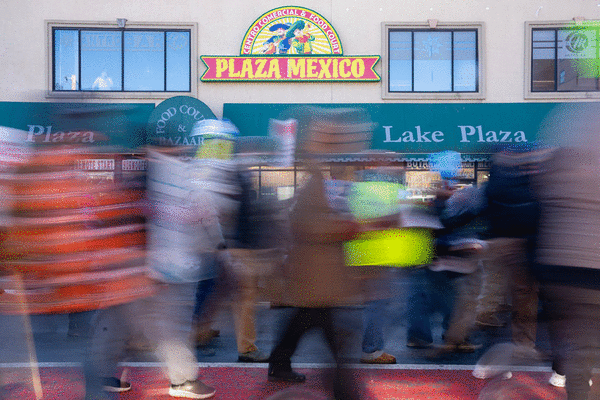
Roughly 80% of immigrant owned businesses along key corridors in Minneapolis and St. Paul have closed in the past week as employees and customers stay home in fear of ICE agents detaining them.
Both Latino Economic Development Center on the east side of St. Paul and the Lake Street Business Council both said businesses have lost at least half their sales since the Trump administration started an escalating immigration crackdown in the Twin Cities.
Immigration and Customs Enforcement agents are continually in the area around Seventh Street and Payne Avenue in St. Paul, said LEDC executive director Alma Flores, adding there were some outside the agency’s doors for the third time in three days as she was talking to a reporter.
Allison Sharkey, president of the Lake Street Council, said ICE presence is pervasive in the area around Lake and Chicago Avenue. At one point on Jan. 12, she spotted five teams of ICE agents in three blocks, demanding identification and interrogating people at bus stops, sidewalks and parking lots.
Since late December, sales at independent immigrant-run businesses along the Lake Street and Uptown corridors are down 80% to 100%.
“This is going to have devastating impacts long term,” Flores said.
With no customers or revenue coming in the doors, they won’t be able to issue paychecks or pay their rents or mortgages.
Flores said the fear has increased since an ICE agent shot Renee Nicole Good in her car on Jan. 8 in south Minneapolis.
The center, which employs 10 U.S. and naturalized citizens, has been on high alert since last week when ICE agents surrounded the Mexican grocery store across the street and demanded access that the owner refused to give.
On Jan. 12, Flores was driving to her office and watched while ICE agents pulled over a driver on Payne Avenue. That same day, she learned that ICE arrested an LEDC business owner at his restaurant, after he refused to identify the location of his dishwasher.
“This is worse than COVID, because at least the federal government was on your side to help,” Flores said. “It’s no longer about what they said they were trying to do with deportations in terms of creating safety for our communities. They are terrorizing our communities, even beyond just Somalis and Latinos.”
Along Lake Street over the weekend, the doors were locked and a security guard stood at the ready at Colonial Market Grocery Store on Lake Street in Minneapolis. A sign on the door said, “Everyone IS welcome HERE! Except I.C.E.”
A worker screened each customer before permitting entry into the Mexican American grocery store that opened 13-months ago with much fanfare.
Few customers were inside. The shelves, tables and fixtures in the front of the store were removed. There are not enough customers or workers to keep the business fully operational, employees said.
Most of the businesses along Lake also have locked doors and security.
“It’s devastating,” said Sharkey, who also said businesses say the effect is worse than the pandemic.
“Right before Christmas, a lot of businesses were telling us sales were down 50%, 70%, or 80%. Now this week? For a lot of business, it’s down to zero,” Sharkey said.
At Plaza Mexico at Lake and Portland Avenue, five blocks from Good’s killing, vendors haven’t opened for business for two weeks.
Less than a mile west, inside Mercado Central, just one of seven restaurants and three of 15 remain open.
Near the market, just off Lake Street, only 30% of Somali-owned shops in Karmel Mall are open.
“In some cases, volunteers from the community are coming and stationing themselves at the door to unlock it for customers. That’s helping (businesses) stay open,” Sharkey said. “I think a lot of the business right now is coming just from those intentional efforts of allies.”
Parents and teachers from nearby schools and church groups have organized efforts to bring business to the stores and restaurants.
”It’s happening in a very grassroots way,“ Sharkey said.
The Lake Street Council is encouraging more people to shop beyond Cub and Walmart to spend money at the immigrant-owned markets.
The disruption has spread beyond the immigrant neighborhoods in the cities as well.
Minnesota State Rep. Patty Acomb, who represents Minnetonka and Wayzata, said constituents including business owners have called her all week.
Businesses across the Twin Cities, including Minnetonka, Wayzata and Edina, are also hurt because hospitality workers are afraid to come to work. Restaurants and some health centers have had to cut hours, she said.
“This is the collateral damage and the impact of this ICE presence. It’s an untold story,” Acomb said.
_____
©2026 The Minnesota Star Tribune. Visit startribune.com. Distributed by Tribune Content Agency, LLC






Comments