Nearly a third of Latino adults rely on their smartphone for internet access, a new Pew study finds
Published in News & Features
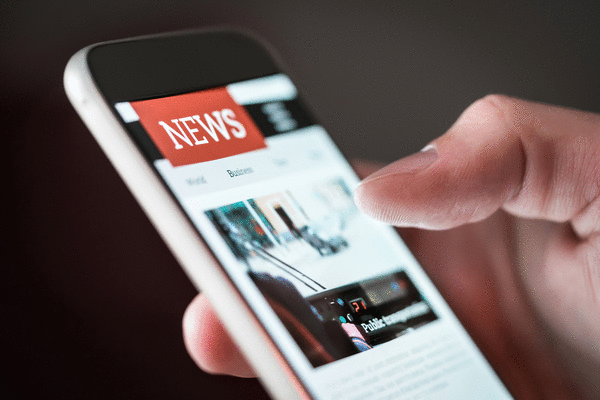
Nearly a third of Latino adults without home broadband rely on their smartphone for internet access.
A new analysis by the Pew Research Center found that 28% of U.S. Latino adults are smartphone dependent, meaning they rely on their handheld device for internet access as opposed to broadband — also known as high-speed internet.
Smartphone dependency among Latinos has more than doubled over the last decade.
In contrast, only 19% of Black adults, 13% of whites and 11% of Asians are smartphone dependent.
In a digital age when access to the internet has become an essential tool for everyday life, not having broadband access can limit one’s access to online health care and education resources, as well as job growth opportunities, according to the Federal Communications Commission.
The Los Angeles Public Library is trying to bridge the digital gap in the community.
In 2022, the LAPL launched its Tech2Go program to mitigate the digital divide for its patrons, providing mobile hot spots and Chromebooks weeks or months at a time to those who might not gain access to the web otherwise.
Library assistant Michael Rodrigson says it gives individuals a “ sense of freedom.”
“We live in a very digital world, it’s not just for entertainment anymore,” says Rodrigson. “A lot of jobs require you to have access to the internet — students need it for research, to get access to resources to help them with their classes.”
Over the last decade, researchers have found that low-income households are far less likely than their higher-income peers to subscribe to broadband internet at home. Black and Latino adults are also less likely than white or Asian adults to subscribe to broadband.
The national data follow similar trends observed in California in recent years.
A 2022 analysis by the Public Policy Institute of California found that 87% of white households in the state had access to high-speed internet, compared with 83% of Black households and 80% of Latino ones.
A 2025 analysis by USTelecom Assn., a nonprofit corporation, revealed that although broadband prices for today’s most popular services have declined by 43.1% over the last 10 years, the overall costs of most households have risen by 35.8%, making it difficult for families to upkeep the subscription.
The Tech2Go program has become a more cost-effective alternative to an added broadband service. It is so popular with library patrons that Rodrigson says it has become “an integral part of our community.”
“It also helps with neighbors who are not houseless, (those who) don’t have internet at home or they have internet but it’s not the best internet,” says Rodrigson.
However, the wait time for these laptops and hot spot devices has increased, Rodrigson says.
“It’s a frustrating point for a lot of our patrons because it’s such a well-loved and much-needed program that it is a little frustrating to see their wait times increase so much,” says Rodrigson. “We are just fighting to keep the program going, period.”
Last year, the LAPL had a pending application for a grant under the Digital Equity Act. The measure, which passed under Biden’s bipartisan Infrastructure Investment and Jobs Act, would have provided $2.75 billion to states and territories to promote digital equity and inclusion. The Trump administration canceled the grant program last May, which came as a blow to many public libraries looking to enhance their digital access programming.
If the funding had gone through, the LAPL was planning to reinforce its popular Tech2Go initiative, as well as expand additional support for Angelenos through the Cybernauts program, a digital inclusion program similar to Best Buy’s Geek Squad. The grant would have funded additional positions for staffers to visit locations outside library centers, including senior centers, says Edwin Rodarte, senior librarian.
“The community still needs (these services), people without internet or that are just relying on cellphone internet,” says Rodarte. “I definitely think that having additional funds would be beneficial for our community, ‘cause we can only allocate so many dollars or taxpayer dollars towards it and we don’t have nearly enough devices that we would need to keep this on board.”
FCC’s Affordable Connectivity Program, which provided eligible low-income Americans with a monthly credit off their internet bills, was also cut in 2024 because of lack of funds.
”The size of (the FCC’s Affordable Connectivity Program) and also the amount of people using it really indicated that there was a need,” says Caroline Stratton, research director at the Benton Institute for Broadband & Society, which supports a broadband-for-all agenda.
However, the Broadband Equity Access and Deployment Program (BEAD) Program — which passed under Biden’s Infrastructure Investment and Jobs Act — is still a go. The $42.45 billion federal grant program aims to connect every American to high-speed internet.
California submitted its billion-dollar proposal before the end of 2025, and now awaits a decision by the National Telecommunications and Information Administration.
On a more local level, California’s Public Utilities Commission’s Last Mile federal funding account has provided $1.1 billion to 52 counties to provide Californians with access to high-speed broadband service.
The California Department of Technology’s “middle-mile” network is also building a statewide, open-access fiber optic network to connect unserved/underserved communities to high-speed broadband by creating wholesale access to internet service providers.
“ We’re at a point where [internet access] is essentially mandatory for life in the United States, if you were going to participate in nearly any aspect of civic life, social life, economic life, political life — connectivity is required,” says Stratton.
©2026 Los Angeles Times. Visit at latimes.com. Distributed by Tribune Content Agency, LLC.






Comments