'Risks and uncertainty' remain high in new California Gov. Gavin Newsom economic forecast
Published in News & Features
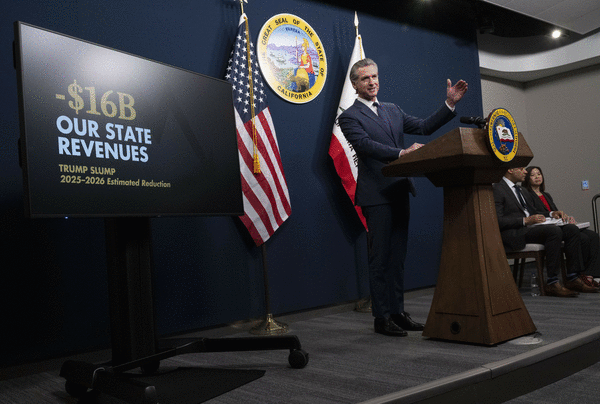
SACRAMENTO, Calif. — Gov. Gavin Newsom’s budget Friday painted a somewhat brighter picture of California’s economy than was forecast last year, but warned that “risks and uncertainty remain elevated.”
The budget forecast, similar to that of independent analysts, offers a better outlook than the governor’s May revision. But it also is full of caution lights that suggest the economy could be in for trouble.
The budget cites the same variables that concern economists all over the country about the national outlook: Tariffs, immigration and inflation.
In recent months, the national economy has been growing at a decent pace. The impact of President Donald Trump’s tariffs has not been as Newsom’s budget writers feared this spring, as the levies on imported goods have not been fully passed along to consumers.
Combined with stronger consumer spending than anticipated, the Newsom budget saw the U.S. economy growing by 2.2% this year, an increase over the 1.5% it predicted last spring.
Another major change involved the cost of living. The May forecast saw a 3% inflation rate from 2025 to 2027; that was revised Friday to 2.7%. Most independent economists’ predictions are also in that range. The federal Bureau of Labor Statistics is scheduled to report Tuesday on 2025 inflation.
On a less upbeat note, California’s November unemployment rate was 5.5%, the highest in the country. The national rate was 4.6%.
The Friday budget revised nonfarm payroll employment levels and growth lower than the May figures, citing a “sluggish labor market.”
Threats to the California economy
What most concerns state and national economic experts are the uncertainties involving tariffs, immigration and inflation.
The Newsom budget cited “the fast-moving and unpredictable nature of federal policymaking, especially as it relates to international trade and immigration.”
It saw “significant uncertainty persists regarding the future path of tariffs and potential retaliatory actions by trade partners, as well as immigration policy and other federal actions that could materially affect economic conditions.”
More and higher tariffs, and companies willing to pass through those tariffs to consumers, would “negatively impact household consumption and business investment, likely resulting in weaker economic growth” than anticipated, the budget said.
It described trade turmoil as having the potential to lead to “renewed volatility in financial markets, which would disproportionately affect high-income households and negatively impact state revenues.”
Immigration and the economy
Immigration policy has a notably outsized effect on California’s economy – a reality noted in Newsom’s budget. “Increased deportations and restrictions on international immigration would likely constrain labor supply, particularly in California, which has a disproportionately large immigrant workforce,” the budget said.
“Labor shortages could place upward pressure on costs and limit economic output, while reducing employment growth across a range of industries,” it warned.
Inflation and monetary policy are another risk to the state’s economic health. The Federal Reserve lowered its target interest rates last month to the 3.5% to 3.75% range.
But, the budget said, “There is a risk that inflation could be more persistent or higher than anticipated, which could prompt the Federal Reserve to pause rate cuts or reverse course and increase interest rates.”
____
©2026 The Sacramento Bee. Visit at sacbee.com. Distributed by Tribune Content Agency, LLC.






Comments