NASA bringing Crew-11 home early after medical issue on space station
Published in News & Features
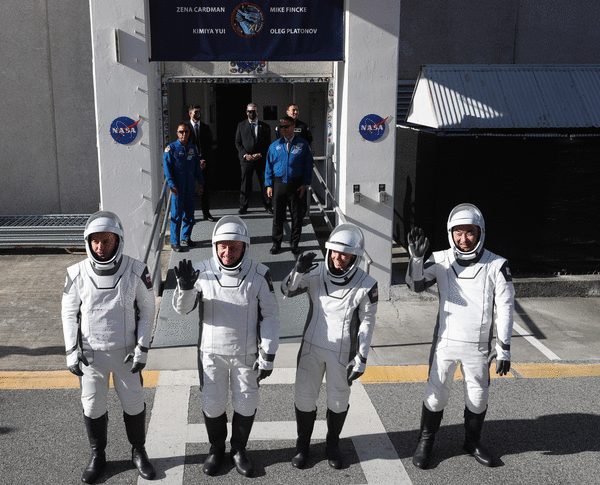
NASA is opting to bring home the four members of Crew-11 early after one of them suffered a medical incident on board the International Space Station.
Without revealing their identity, NASA said the astronaut experienced the issue on Wednesday afternoon, and is in stable condition.
“NASA has set the standard for safety and security and crewed space flight in these endeavors, including the 25 years of continuous human presence on board the International Space Station, the health and the well-being of our astronauts is always and will be our highest priority,” said NASA Administrator Jared Isaacman during a press conference Thursday.
Coming home “in the coming days” will be NASA astronauts Mike Fincke, 58, and Zena Cardman, 38, along with JAXA astronaut Kimiya Yui, 55, and 39-year-old Roscosmos cosmonaut Oleg Platonov.
The quartet launched to the ISS from Kennedy Space Center on Aug. 1 last year and had been scheduled to stay on board until the arrival of Crew-12, which NASA had slated for launch no earlier than Feb. 15.
Dr. James Polk, NASA’s chief health and medical officer, said it’s not an emergency situation.
“The astronaut is absolutely stable. So I have to reiterate that again. But anytime we have a medical incident, we embark on looking at diagnoses and what we would call a workup to get a differential diagnosis on what’s happening with that patient or astronaut on board,” he said
While he noted there is a robust suite of medical hardware on orbit, the space station doesn’t have all of the hardware that would be in an emergency department.
“The medical incident was sufficient enough that we were concerned about the astronaut that we would like to complete that workup,” he said. “And the best way to complete that workup is on the ground where we have the full suite of medical testing hardware.”
While the SpaceX Crew Dragon Endeavour will be leaving shortly, NASA officials said it’s not as urgent as it could be. Astronauts could be evacuated in the matter of hours if necessary.
“We’re not immediately disembarking and getting the astronaut down, but it leaves that lingering risk and lingering question as to what that diagnosis is, and that means there’s some lingering risk for that astronaut on board,” Polk said. “And so always, we err on the side of the astronauts’ health and welfare. And in this particular case, we are doing the same.”
The medical issue came to light Wednesday afternoon when NASA called off a planned spacewalk involving Fincke and Cardman.
“This actually had nothing to do with the operational environment in preparing for a spacewalk at all,” Polk said. “This was totally unrelated to any operations on board. And of course, we do a huge amount of testing for astronauts before they go to orbit.”
Fincke, a member of the 44-candidate NASA class of astronauts chosen in 1996 known as The Sardines, is amid his fourth trip to space. His previous missions included the last flight of Space Shuttle Endeavour in 2011. Cardman, the commander of Crew-11, is the final member of the 2017 class of astronauts known as The Turtles to make it to space.
Yui is on his second spaceflight and Platonov is on his first.
With their departure, the space station’s population will drop from seven to three.
Remaining on board are NASA’s Chris Williams and Roscosmos cosmonauts Sergey Kud-Sverchkov and Sergey Mikaev, who flew to the station on a Soyuz spacecraft in November.
As far as the SpaceX Crew Dragon missions have gone, NASA has sent crews home earlier before the arrival of their relief in the past, but NASA’s preference is for a short handover period. Crew-11 was originally targeting a return of late February.
When they do depart, Endeavour is expecting a normal return with a planned splashdown in the Pacific Ocean.
Polk said this is the first time NASA has opted to fly home early because of a medical concern, but it’s not the first time one has happened.
“Fortunately for us, we’ve had equipment and medications and things to be able to handle all of those such that we were able to complete the treatment and order the diagnosis on orbit over the last 25 years,” he said.
_____
©2026 Orlando Sentinel. Visit orlandosentinel.com. Distributed by Tribune Content Agency, LLC.






Comments