We talked to 5 use-of-force experts. This is what they say about the Minneapolis ICE shooting
Published in News & Features
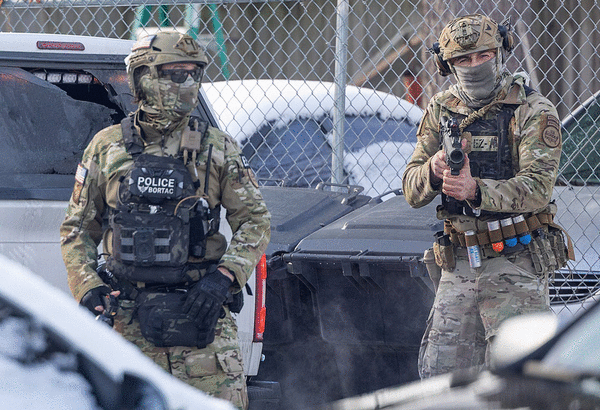
MINNEAPOLIS — Almost immediately after an ICE agent fatally shot 37-year-old Renee Nicole Good, federal officials began describing the episode as a justified use of force. Department of Homeland Security Secretary Kristi Noem said the agent acted in self-defense and accused Good of using her vehicle as a weapon.
The agency’s critics, including several Democratic officials in Minnesota, cast the agent’s action as reckless and preventable.
The Minnesota Star Tribune spoke to five legal experts on the use of deadly force by law enforcement to get their views on what happened and the issues involved. Their views, of course, are limited by the information that is known.
Four of the experts had watched videos of the shooting — images that show some, but not all, of the confrontation in the moments before Good appears to drive her car forward toward an agent and he opened fire.
All of the experts questioned the agent’s decision to shoot at a moving vehicle, with some outright calling it a “bad shooting.” Others said the agent who fired may have legitimately feared for his life, but they noted that most police departments discourage shooting at a moving vehicle because deadly force is unlikely to stop the car and could jeopardize bystanders.
Here is a breakdown of the key issues raised by the shooting.
The Minnesota Bureau of Criminal Apprehension and the FBI were discussing a joint investigation in the hours after the shooting, but BCA officials later announced that federal officials had decided to operate independently and would not be sharing information.
Legal experts said it is unusual for federal officials to investigate without teaming up with local authorities, in part because they want to prevent any bias from tainting the results.
“It could hamper the state’s ability to conduct an investigation to some degree,” said John Gross, a law professor at the University of Wisconsin in Madison. “The local folks may not know what agents were on the scene and even if they do, those guys may not cooperate with them — they may not give them a statement.”
At a news conference on Thursday, Jan. 8, BCA officials said they may not be able to present a case for prosecution if they can’t get access to evidence gathered at the scene of the fatality.
Immigration and Customs Enforcement is a federal agency. Under federal rules, deadly force may only be used if an officer “has reasonable grounds to believe such force is necessary to protect the designated immigration officer or other persons from the imminent danger of death or serious physical injury.”
An agent who violates those rules can be punished administratively, such as a suspension or even termination.
Minnesota law is similar, but it also allows for the use of deadly force if an officer believes the fleeing individual may have already committed a felony and will likely kill or seriously injure someone else if they escape police custody.
Legal experts were stunned at the rapid response by top federal officials to the incident in Minneapolis, with Noem publicly defending the shooting and calling Good’s actions “domestic terrorism.” The experts said authorities typically refrain from such comments before conducting an investigation because they don’t want to sway the investigation.
“I think that was wildly irresponsible,” said Seth Stoughton, a law professor at the University of South Carolina. “There are certainly situations where there is significant evidence that might suggest an early conclusion, but even in those cases no responsible agency will announce what appears to be a definitive conclusion prior to a full investigation.”
Legal experts said most departments train officers to refrain from shooting at a moving vehicle, in part because of the danger such action could pose to officers and others in the surrounding area if the driver was incapacitated.
“Most police departments in the country — including Hennepin County — have policies that prohibit officers from firing at moving vehicles,” Gross said. “There are very few narrow exceptions to that rule.”
In many jurisdictions, experts said, the vehicle itself would not be considered a weapon unless someone is using it in a mass casualty event, such as driving a truck into a crowd of people.
Dennis Kenney, a professor at the John Jay College of Criminal Justice in New York, said such rules proliferated because shooting at a moving car doesn’t stop the car and often forces the driver to lose control of the vehicle.
That’s what happened this week in Minneapolis, Kenney noted. Good’s car continued moving forward and struck at least one other vehicle. Experts said the car could have easily hit a bystander.
“If someone is trying to get away from the police and their attempt does not endanger someone, then the use of deadly force would be inappropriate,” said Stoughton, who had not yet seen the video.
Four of the experts who spoke to the Star Tribune had seen videos that documented the encounter. None of the experts said the available evidence proved the shooting was justified.
“I would say it’s a bad shooting,” Kenney said. “In my view, the video shows the officer who did the shooting deliberately moved himself into a blocking position and clearly had time to get out of the way — because he did.”
Gross agreed, saying he saw nothing in the publicly available videos that would justify deadly force.
“I don’t see how anybody who is a conscientious member of law enforcement could view that video and not have serious concerns about what the officer did,” Gross said.
Mylan Masson, a retired Minneapolis police officer who directed police training programs in Minnesota, said she views the shooting as “questionable” because the investigation is ongoing and not all of the relevant facts are known.
Jeffrey Noble, a former deputy police chief in Irvine, Calif., said a “reasonable officer” would have taken a step or two away from the vehicle to get out of harm’s way. “He didn’t do that,” Noble said.
All of the experts agreed that local authorities could prosecute the ICE agent if the evidence warrants criminal charges, even if federal authorities find his actions to be justified.
That decision would likely be made by the Hennepin County Attorney’s Office. Spokesman Daniel Borgertpoepping said the office would have jurisdiction to bring criminal charges against federal officers involved in the shooting.
“States can prosecute federal officers for violating state criminal laws, and they have a long history of doing that,” said Bryna Godar, staff attorney at the State Democracy Research Initiative at the University of Wisconsin Law School. “Federal officers do have immunity in some circumstances, but that protection only applies if federal officers are reasonably acting and carrying out lawful federal duty. ”
But experts said criminal charges are rare.
“Most often it is a civil matter,” Kenney said. “Bringing a criminal charge against an officer is a very difficult thing to do. It takes a fairly egregious example to bring a prosecution, particularly to successfully prosecute.”
Legal experts said key evidence that would determine whether charges are filed include where the officers were at the time of the shooting. For instance, they said, an officer may have feared for his life if he was standing in front of the vehicle instead of beside it.
“The general rule of thumb is if you have time to shoot you have time to get out of the way,” Kenney said. “So the explanation that you felt your life was at risk is generally not well received.”
According to news outlet the Trace, at least 14 people have been shot at by ICE agents since July. Most did not result in injuries.
In September, an ICE officer fatally shot Silverio Villegas González after the Mexican national allegedly tried to evade arrest. Federal officials said an officer was dragged by González’s vehicle.
In October, a Border Patrol agent shot Marimar Martinez several times during another Chicago operation.
Federal prosecutors initially charged Martinez, an American citizen, accusing her of ramming her vehicle into an agent’s car and boxing it in. The U.S. Department of Justice later dropped charges accusing Martinez and another defendant of using vehicles to assault, impede and interfere with the work of federal agents.
Martinez’s attorneys said federal agents hit her car.
________
(Walker Orenstein and Jeff Day of the Minnesota Star Tribune contributed to this story.)
________
©2026 The Minnesota Star Tribune. Visit at startribune.com. Distributed by Tribune Content Agency, LLC.




Comments