In final budget address, Beshear bets on modest pre-K start, teacher raises
Published in News & Features
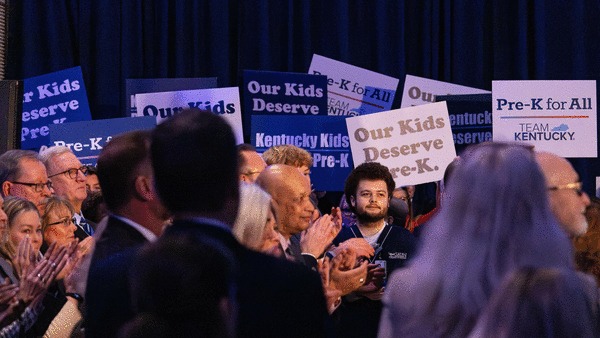
The funding request from Democratic Gov. Andy Beshear for a pre-K for all initiative looks different from what he pitched two years ago. And this year’s ask could be seen as a more politically savvy move as spend-conscious Republicans are increasingly wary of how the state spends its money while the executive remains adamant about the education policy.
In unveiling his executive budget proposal for the next two years, Beshear outlined a multi-year phase-in plan for pre-K that would cost $40.5 million in fiscal year 2028 and a $10 million for a data system to support it.
During his seventh State of the Commonwealth on Jan. 7 that doubled as his final budget address, Beshear called funding pre-K “the most important choice in this session for our future, our businesses, our families and our children.
“The single most effective way we succeed in this next budget is by funding pre-K for all,” he said.
Pre-K aims to boost school readiness while providing programmed child care for children ages 3-to-5. Some states fully fund pre-K for all, but in Kentucky, only some families qualify for low- to no-cost options.
The pre-K funding, which would come from the state’s sports wagering excise tax, would provide for 9,683 additional 4-year-olds to attend pre-K in school districts that express their readiness to participate.
It’s a relatively modest request compared to what he asked for in 2024: an annual recurring cost of $172 million to start to cover for 34,000 Kentucky 4-year-olds.
But pre-K for all was only one part of his budget proposal.
Other parts of the proposal touch on affordability, investing in public education and addressing the loss of federal funding for Medicaid and the Supplemental Nutrition Assistance Program. Overall, Beshear’s budget proposal allocates around $15.8 billion in general fund expenditures for fiscal year 2027 and $16.5 billion for fiscal year 2028.
It’s hard to say what, if anything, from Beshear’s proposal may be adopted, as Republicans have a supermajority in the state legislature. The GOP caucus has yet to release its version of a full state budget, but has been adamant during the first week of session it’s in progress.
In a joint statement from Speaker of the House David Osborne, R-Prospect, and Senate President Robert Stivers, R-Manchester, following the governor’s remarks, the pair said the state is well positioned today due to policies enacted by Republican supermajorities.
“These policies have produced a record budget reserve trust fund and allowed us to responsibly lower the state income tax. Our legislative focus will remain on protecting core investments, ensuring responsible stewardship of taxpayer dollars, and avoiding commitments the commonwealth cannot sustain,” the GOP leaders said. “We will continue to prioritize measured growth, accountability, and long-term stability.”
Pre-K for all
Beshear has put forward a modest request for a multi-year phase-in plan to achieve pre-K for all. The governor has repeatedly sung the program’s high praises as a tool to bolster the state’s economic development strategy, to provide for families and the future of the workforce as well as put the state on a path for long-term economic growth.
“To members of the General Assembly: We were able to work together on medical cannabis, to make sports betting legal, to protect horse racing and gaming and our horse industry,” Beshear said. “Surely we can come together for 4-year-olds. Pre-K for all is the right thing to do.”
Since the start of his second term, Beshear’s administration has dedicated time and resources to setting the state up for delivering universal pre-K, including establishing an advisory committee that’s hosted town halls.
Republicans have yet to embrace Beshear’s push for pre-K. Some have said the policy is necessary, but the governor’s funding approaches — until now — are unclear, seem to be too big and don’t quite match up to their own priorities for how the state should be spending money.
Though he said the policy isn’t political, implementing pre-K for all and finding the money to fund the education program would be a feather in Beshear’s cap as he positions himself to potentially seek higher office once his governorship is over in 2027.
Other education priorities
It’s been a big push from Beshear in years past, and he’s on it again: raises for Kentucky teachers.
“Our priority — always — must be the future, and our future is molded in our public schools,” the governor said. “I am unapologetically a 100% pro-public education governor.”
The price tag on those proposed raises? About $159 million per year to school districts to help fund mandatory raises, and a 7% raise over the next two years, a majority of which is funded by teachers keeping one of their regular payments into the Teachers’ Retirement System.
Prior efforts to secure raises have been swatted down by the legislature.
Beshear and his staff have argued that state-mandated raises are necessary to uplift teachers and keep school districts competitive, but Republicans counter that districts themselves should decide on what raises they should give, opting instead to put money into the state funding formula known as SEEK.
Beshear’s budget proposal ups the SEEK funding by 11.6% over the next two years, but much of that is earmarked for specific purposes. The base per pupil formula would increase by 2.5% each year, from the current $4,586 mark to $4,818.
Other earmarks for SEEK funding include a 3% pay increase for full-time school district employees, $108 million for school facilities funding and $134 million for retirement contributions.
Beshear’s postsecondary education budget proposal does not include major changes. It would support granting $42 million in escrow funds to Eastern Kentucky University for its proposed osteopathic medicine program, which would come from the Budget Reserve Trust Fund and be returned once the program has met the accreditation agency’s requirements.
Health care
As Kentucky’s Medicaid program prepares to face changes because of decisions at the federal level, Beshear’s budget fully invests in the program. That investment includes an additional $420 million from the General Fund for fiscal year 2028.
Congress last year passed House Resolution 1, also known as the ‘One Big, Beautiful Bill,’ which had substantial impact on Medicaid. Those changes include adding work requirements for Medicaid expansion members and changing the frequency of eligibility determination to every six months instead of one year starting in January 2027.
According to Beshear’s 2026-2028 executive budget summary, the Medicaid eligibility forecast group predicts the estimated enrollment reduction is 28,539 in fiscal year 2028 because of these two changes.
Beshear also addressed concerns of how Medicaid cuts could impact rural hospitals. During the ‘One, Big Beautiful Bill’s passage process, U.S. Senate Democrats sent a letter to President Donald Trump estimating 35 Kentucky hospitals could close because of the legislation.
In his budget, Beshear included a $125 million rural hospital fund to prevent rural hospitals from closing.
There’s also $100 million provided to help lower the cost of kynect, the state’s health insurance exchange.
Families and children
Beshear proposes spending $43.5 million in fiscal year 2027 and $58 million in fiscal year 2028 for administrative costs shifted to the state for the Supplemental Nutrition Assistance Program.
His budget also suggests spending:
•$22 million each year from the General Fund to maintain out of home care services for youth in the custody of the Cabinet for Health and Family Services.
•$14.6 million each fiscal year to fund the Relative and Fictive Kin foster care reimbursements and to support the increase in caseload of social service workers.
•$9.1 million each fiscal year to continue providing nutritional meals for senior citizens.
Public safety
One of Beshear’s main proposals for public safety is building a new reentry campus at Northpoint Training Center in Burgin, a small city southwest of Lexington in Mercer County.
The project, which is budgeted for $42 million, will ask the Kentucky Community and Technical College System to provide vocational technical education programs for up to 400 inmates. Intensive reentry services to prepare inmates for jobs upon release will also be part of programming.
Additionally, Beshear is pitching:
•Constructing a new high-acuity youth facility for juveniles in detention needing mental health and medical services.
•Supporting the expansion of drivers testing locations at three existing Transportation Cabinet locations and adding six new locations. Those additional costs would be $1.3 million in FY 2027 and $3.4 million in 2028.
•Providing capital funding for two new female-only juvenile detention centers.
Other infrastructure projects
Beshear also included multiple investments and infrastructure projects, including:
•$125 million from the Budget Reserve Trust Fund for the Brent Spence Bridge Project.
•A $319 million investment for Kentucky’s drinking water and wastewater revolving loan fund.
•A recurring annual investment of $570 million for Kentucky’s existing pavements and bridges.
•Returning the Highway Construction Contingency account funding to $31 million.
•A $150 million investment in Kentucky’s Affordable Housing Trust Fund.
©2026 Lexington Herald-Leader. Visit at kentucky.com. Distributed by Tribune Content Agency, LLC.



Comments