China courts South Korea as it pressures Japan over Taiwan
Published in News & Features
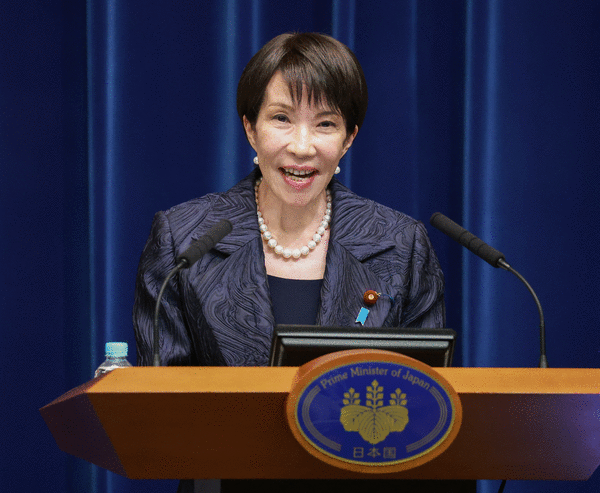
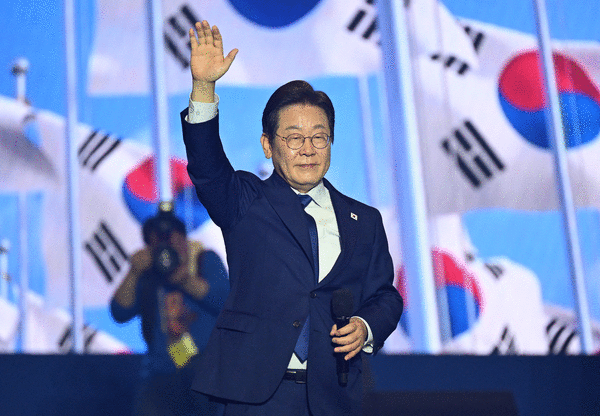
Hours after President Xi Jinping posed for selfies with South Korea’s Lee Jae Myung in Beijing, China sent a very different message to Japan, escalating their dispute by imposing export controls.
The new restrictions bar exports of all dual-use items to Japan for military purposes, the latest step in a dispute triggered by remarks by Prime Minister Sanae Takaichi in November suggesting Tokyo could deploy its military in the event of a Chinese attack on Taiwan.
South Korea, by contrast, is being courted. Lee’s visit to Beijing — his second meeting with Xi in just over two months and the first by a South Korean president since 2019 — was accompanied by a 400-member business delegation, at a time when hundreds of Japanese executives had to put their trip to China on hold as bilateral ties deteriorate.
“Beijing is clearly trying to drive a wedge between Korea and Japan, hoping to leverage Lee’s desire to restore ‘balance’ to Korea’s foreign policy with his party’s longstanding anti-Japan streak,” said Jeremy Chan, a senior analyst at Eurasia Group and a former U.S. diplomat in China and Japan.
The contrasting treatment of Seoul and Tokyo is also meant as a broader signal. By pressuring Japan while engaging South Korea, China is seeking to isolate governments that openly challenge its position on Taiwan, and to encourage others to show restraint when it comes to publicly backing the island.
In a moment underscoring the warming ties between Seoul and Beijing, Lee posted a selfie with Xi and their wives on X. The photo was taken with a Xiaomi phone that the Chinese leader gifted Lee during his last visit to South Korea. “Thanks to you, I got the shot of a lifetime,” Lee said.
Relations between Beijing and Seoul have not always been so cordial. Ties plunged after South Korea decided to deploy the U.S. THAAD missile defense system in 2016, a move China denounced as a threat to its security.
Since taking office in June 2025, Lee has signaled a more balanced approach to foreign policy than his predecessor Yoon Suk Yeol, who prioritized closer alignment with Washington. Still, South Korea’s status as a U.S. ally limits how far it can move toward China.
At their meeting on Monday, Xi pointed to the frequency of their recent summits as evidence of the importance of China-South Korea ties, urging Seoul to “stand on the right side of history.”
He also brought up the two countries’ shared history of fighting Japanese militarism, saying that they should “join hands to defend the fruits of victory in World War II and safeguard peace and stability in Northeast Asia.”
Lee said the summit could make 2026 the first year of a full restoration of South Korea-China ties. He reiterated Seoul’s respect for the “One China” policy, according to Xinhua News Agency, echoing remarks he made days earlier in an interview aired by state broadcaster CCTV.
China-Japan ties
Meanwhile, Japan’s relationship with China has moved in the opposite direction. Ties soured in early November after Takaichi said a Chinese invasion of Taiwan could be deemed a “survival-threatening situation,” a legal justification that would allow Japan to deploy its military.
China, which claims Taiwan as part of its territory, has repeatedly demanded she retract the comments. Takaichi has refused, maintaining that Japan’s policy on Taiwan remains unchanged.
Beijing has responded with a series of punitive measures, including the new export controls that didn’t specify which shipments to Japan would be affected. China is considering tighter export license reviews for certain rare earth-related items, state-run China Daily reported. It has also restricted Japanese seafood and films while discouraging its citizens from traveling to Japan.
For now, South Korea appears to be reaping some benefits. As Chinese travel to Japan has slowed, South Korea has seen a surge in visitors in November. Korean retail and consumer stocks have also gained as investors bet that worsening China-Japan ties could redirect spending toward South Korean businesses.
Lee has sought to position himself as a potential mediator and is set to visit Japan later this month. The strained relationship between Xi and Takaichi could make both sides more open to deeper engagement with Seoul.
“That Lee sought to meet with Xi before heading over to Nara later this month indicates that Lee is open to shuttle diplomacy, although it will be a very difficult balance to strike,” Eurasia Group’s Chan said.
Despite the positive vibes in Beijing, one of South Korea’s most pressing requests remains unresolved. China’s informal ban on Korean entertainment has been in place since the THAAD deployment nearly a decade ago.
A reopening of China’s entertainment market would be a major boost for South Korea’s cultural exports and was a key item on the agenda for Lee’s visit. But Seoul officials said more time would be needed to make progress. Details were also scarce on other sensitive issues, including North Korea’s denuclearization.
China’s decision to agree to a state visit so soon after Xi’s trip to Korea “likely reflects its perception of South Korea as among the weaker link among U.S. allies, compared to Japan,” said Park Won Gon, an international relations professor at Ewha Womans University in Seoul.
“For Seoul, maintaining functional relations with Beijing is a strategic necessity as much as an economic one,” Park said. “Both the U.S. and Japan would have closely monitored the meeting.”
_____
(With assistance from Colum Murphy and Cat Barton.)
_____
©2026 Bloomberg L.P. Visit bloomberg.com. Distributed by Tribune Content Agency, LLC.





Comments