After Maduro's capture, Venezuelans in Washington state ask: 'Should we be happy?'
Published in News & Features
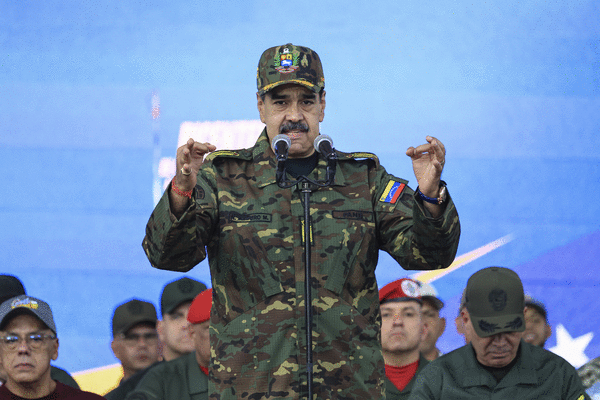
Adriana Figueira felt a wide range of emotions Saturday at the news that Venezuelan President Nicolás Maduro was no longer in power because he and his wife had been captured in a surprise attack by the U.S. military.
“I was very joyful,” about Maduro’s ouster, said Figueira, an asylum-seeker who came to America in 2023 and was among scores of migrants who sheltered at the Riverton Park United Methodist Church in Tukwila, Washington.
But she’s unsure about her country’s future after a dozen years under the Maduro regime.
“There are so many Venezuelans who have left the country because of the extreme situation in Venezuela,” she said in Spanish. “The amount of people who have died … family members who we won’t be able to see again because we’ve had to migrate forcefully due to the few resources that we have in Venezuela.”
Still, she’s troubled because President Donald Trump’s plans remain unclear. Trump said at a news conference Saturday that the U.S. will “run” the country and that U.S. oil companies will oversee its rich oil reserves. It was also unclear who was in charge.
“On one side, this is a president who has attacked us here in this country for leaving Venezuela,” Figueira said. “This president took the risk of supporting our Venezuelan territory, knowing that we lived in a dictatorship. But also we know that in this country, in the United States, there are a lot of laws that don’t benefit us Venezuelans.”
Washingtonians with roots in the South American country shared similar sentiments: elation at the hope of free and fair elections and optimism that the thousands of Venezuelans who fled their country during the past two decades could return home. But the next steps remain tenuous, with concern about whether the Venezuelan people would truly see a windfall from the country’s oil and mineral resources, as Trump claimed Saturday.
‘One step at a time’
Meanwhile, about 100 people rallied in Seattle denouncing the military action and Maduro’s removal.
“Hands Off Venezuela” protests were held throughout the Puget Sound region and called for the U.S. to stop military action in Venezuela.
On the Overlook Walk near Seattle’s waterfront Saturday afternoon, protesters held signs that read “No blood for oil” and “No U.S. war on Venezuela,” while some held up Venezuelan flags. Speakers commented on the bombings, what they said was the need for the people of Venezuela to run their country and what they called violations of international law.
The protest, along with dozens across the country, were organized by the ANSWER Coalition, a national antiwar organization.
Several Washington lawmakers walked a fine line, blasting the military operation as “illegal,” while noting that Venezuela had been ruled by a “corrupt and oppressive” dictator. U.S. Rep. Pramila Jayapal called the action “an illegal and unconstitutional attack” that lacked congressional authorization.
“The American people didn’t ask to start a war with Venezuela,” U.S. Sen. Patty Murray said in a statement. “They didn’t ask for an indefinite and costly occupation of another country and they didn’t ask for ‘boots on the ground,’ their sons and daughters put in harm’s way. All they asked for were lower prices at the grocery store.”
Ivonne Duque, an interpreter from Mill Creek, left Venezuela 26 years ago during Hugo Chávez's regime.
Last year she met her father and a few relatives at the Colombian border because she feared that as an American citizen she could be kidnapped if she entered the country. Duque last visited the country in 2012.
She recalled her fear on Friday night when the bombings started. But that fear about the loss of innocent lives turned to confusion then “huge happiness” once it became clear that Maduro was on his way out.
“It’s a huge relief,” said Duque, who said she now hopes to return without any issues and to take her children with her. Her son, who is now 20, last visited when he was 4. Her daughter, now 16, was a baby at the time and does not remember the visit.
While the future is unclear, Duque said, she doesn’t want to think about that right now. She is worried and hopes there’s a short transition, she said.
“I just want to enjoy the happiness of Maduro being out,” she said.
“I don’t want to ruin my happiness thinking about, ‘How do you feel about the United States doing this?’ It’s one step at a time. I just want to enjoy today, Duque added.
But whatever comes next, “it can’t be worse” than it’s been under Maduro, she said. Still, she’s worried about potential confrontation with the U.S., Russia and China over Venezuela's resources.
‘Should we worry?’
Marines Scaramazza, owner of the Latino Herald, a Lynnwood-based Latino-focused online publication, started getting videos of explosions from friends in Venezuela early Saturday.
“I immediately thought this may be the United States was trying to do something,” said Scaramazza, a Venezuelan immigrant who has lived in the U.S. since 2008. “But I was surprised because I wasn’t sure what the justification the United States was using to attack a foreign country. We all want the best for our country and for our people, but there’s also a gray area where we don’t know what is going on because we were seeing those images of explosions, and people were scared.”
She found herself in emotional limbo: “Should we worry? Should we be happy? On the other hand I was trying to be calm to write the story about it.”
When it was clear that Maduro had been captured, she said it was good news for Venezuelans. She wants free and fair elections, but said she understands that it would take time to rebuild the country’s infrastructure from the ground up.
Trump’s news conference added to the confusion, she said. U.S. officials would be working “as a team” with Vice President Delcy Rodríguez, according to Trump.
“She is a big part of Maduro’s government,” Scaramazza said. “So, it’s like, are we going to get out of the Maduro regime? … We are all waiting for something, for some clarity about what is going to happen with the country.”
Scaramazza said she’d also like the administration to clarify what’s going to happen with the country’s resources.
“Even though the U.S. comes in and takes, let’s say, 70% of the revenues, we will be fine,” she said. “It’s not the best outcome because the resources are for the people of Venezuela. But it’s better than what we have right now. Some of us will think if that is the price we have to pay, we will pay it. But for how long?”
Figueira, an activist who was part of Chávez’s revolution, later fled Venezuela in fear for her life, first to Colombia, then to the United States. Her children, who are 21, 17 and 11, are still in Venezuela.
She does not know how the latest events will affect her asylum case, she said. And she does not know if she’ll see her children anytime soon.
“Going back right now isn’t an option,” Figueira said. “Although this president acted, that doesn’t mean the economic situation is going to be resolved immediately.”
Her family in Venezuela has been glued to the news, she said. They’re buying up food because they do not know what’s next, she added. Figueira hopes immigration and humanitarian laws will change to allow students to be able to leave the country freely, not under duress, and travel without discrimination.
Figueira hopes to see international solidarity with Venezuelans. She hopes the nation “will reestablish itself economically.” And she hopes “to return to my country at some point.”
_____
© 2026 The Seattle Times. Visit www.seattletimes.com. Distributed by Tribune Content Agency, LLC.






Comments