City Hall hiring freezes, including under Chicago Mayor Brandon Johnson, have proved to be more of a chill
Published in News & Features
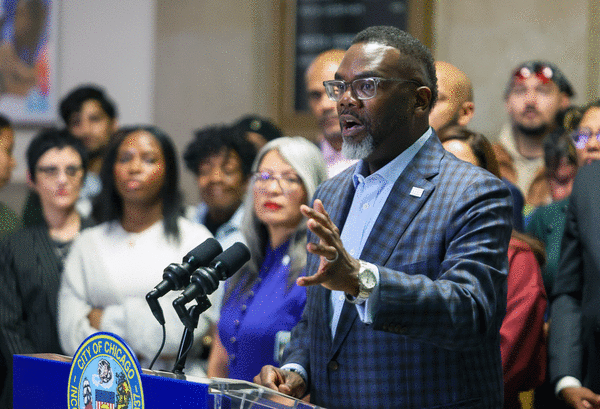
CHICAGO — When Mayor Brandon Johnson faced a long-expected budget deficit this fall, he again turned to a government hiring freeze as a means to save money and show the public that City Hall was taking the problem seriously.
In practice, that “targeted” freeze has proved to be more of a chill, as hundreds of workers were nonetheless brought onto the payroll since the Johnson administration instituted the policy in August, according to city records.
While that follows the pattern of previous hiring freezes under Johnson and his predecessors, a leading mayoral critic nonetheless disapproved of the move when presented with the figures amid tense budget negotiations that only ended the weekend before Christmas.
“Everything with this budget, it’s about trust,” Ald. Matt O’Shea, 19th, said in November. “I don’t believe the math that they’ve come up with … and now to find out that they’ve hired (hundreds of) non-public-safety positions while we were in a hiring freeze? This is nothing but a shell game with them.”
Some financial experts stress that it’s unrealistic for local government to maintain the same level of services without new hires, even if police and fire are excluded. To that end, while no city hiring freeze has truly frozen all new additions to the workforce, the popular spending-control mechanism Johnson has used twice now does its main job of communicating belt-tightening to taxpayers, said Ralph Martire, executive director of the Center for Tax and Budget Accountability.
“Even the symbol of it is important, simply because when you have a difficult fiscal situation, you want to make sure that the public sector that’s facing it isn’t just running up costs for no apparent reason, right?” Martire said. “That’s just part of the deal, to make it clear to taxpayers you’re taking every step to solve your problem.”
Starting with the Aug. 1 kickoff of Johnson’s hiring freeze, his budget office approved 494 more employees in the following three months, according to employee data obtained by the Tribune via a Freedom of Information Act request. Just under half, or 223 workers, were not Police Department and Fire Department hires, the records through Nov. 18 show. Department of Family and Support Services Commissioner Angela Green, hired Aug. 7, netted the highest salary from that pool, at about $213,000.
However, Johnson spokesperson Cassio Mendoza noted the city’s hiring and onboarding process usually takes about three to five months, and if a job offer had already been made then that hire would be approved “so, looking at hire dates is not a good way to measure the impact of a hiring freeze.”
Johnson’s budget director, Annette Guzmán, announced a “targeted” hiring freeze at the end of July as the mayor headed into his third budget cycle with the tall task of closing a $1.19 billion projected deficit for 2026. It was the second hiring freeze his administration has enacted, and both exempted public safety positions. The memo carved out “critical public safety, revenue-generating, mission critical and legally mandated roles” as exceptions.
The freeze only applied to jobs under the city’s Corporate Fund or Community Development Block Grant. The just under 500 hires from the Tribune’s data analysis come solely from the Corporate Fund, which is the main part of the city’s budget that faces deficits every year, while other sources include special funds from the airports or federal and state grants. No CDBG-funded hires were recorded during that duration.
Mendoza said that as of mid-November, the hiring freeze had saved $53 million, with that number projected to rise to $75 million by the end of 2025. In 2024, an earlier city hiring freeze saved $65 million, Mendoza said, after Johnson’s office first anticipated saving about $100 million.
Since the latest freeze began in August, the mayor’s office has hired 16 new positions, the most recent in early November, and most of them were senior leadership and management roles. That office has 124 employees as of this week, according to the Office of the Inspector General dashboard, while the city payroll is about 32,400.
The highest-earning addition to the mayor’s office was Sheila Bedi, hired on Aug. 25 at $198,000 under the job title of chief operating officer, though her position was announced as a “director of strategy.” Records also show Johnson’s office tapping Sabeeha Quereshi as a deputy mayor that same day, announced as a “deputy mayor for Health and Human Services,” although she no longer appears on the city’s employee dashboard maintained by the OIG.
The departments that got the largest pools of new hires were: Chicago police at 256 and the Office of Emergency Management and Communications at 44. The Fire Department, where a significant share of jobs are also exempt, saw only 15 new hires.
Ahead of Johnson’s mid-October budget speech unveiling his $16.6 billion spending plan, which did not include structural layoffs, his budget team elaborated: “Exemptions to the hiring freeze will include positions related to public safety, revenue generation, legislative, elections, consent decree, IT, mental health and litigation savings.”
Aldermen ultimately made the historic move of passing a counterproposal on Dec. 20 over his objections. Among their complaints with the Johnson administration’s handling of this budget was what they said was a reluctance to implement every possible tool for savings and efficiency, including in the workforce.
The mayor’s budget team retorted in a letter to the aldermanic opposition this month that “a targeted hiring freeze … gives the Administration the opportunity to evaluate organizational structures, examine spans and layers, and assess where administrative functions can be centralized or shared across departments while still realizing the financial savings in 2026 that a deeper cut to vacancies would achieve.”
As for last year’s hiring freeze, 483 employees were added from the Corporate Fund by the end of 2024, including 156 who weren’t in the police and fire departments, according to city data from that period. That means the current hiring freeze is resulting in a larger share of positions that are not first responder roles added to the payroll so far, though it’s unclear whether there have been fluctuations in job applicant trends.
In 2019, then-Mayor Lori Lightfoot also implemented a citywide hiring freeze ahead of her first budget plan that faced a looming deficit. From Aug. 20 to the end of 2019, the city hired 583 additional employees, 307 of them outside the police and fire departments, records show.
Martire, the fiscal expert, said if the numbers don’t translate to enough fat-cutting to the average Chicagoan, that might be by design as “your private sector entity is accountable to do one thing, and that is generate a profit. Your public sector entity is accountable to … deliver core public services to everyone who needs them cost-free.”
David Merriman, a professor of public policy, management and analytics at the University of Illinois Chicago, added that the sweet spot for a taxpayer is for some hiring to support the programs most in demand, but said that, overall, “I would expect the total workforce to shrink.”
“In general, hiring freezes are a blunt tool to reduce spending,” Merriman wrote in a statement. “A much better approach is to prioritize city services and to curtail those that are least essential and most readily able to be cut.”
____
©2026 Chicago Tribune. Visit at chicagotribune.com. Distributed by Tribune Content Agency, LLC.






Comments