Saudis urge UAE to withdraw from Yemen after port strikes
Published in News & Features
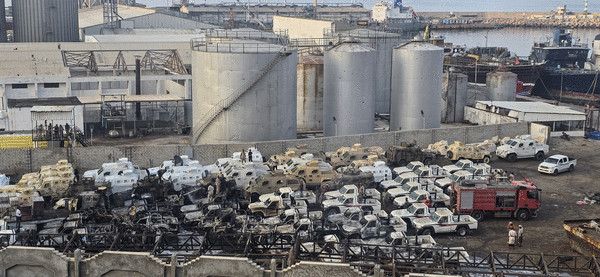
Saudi Arabia told the United Arab Emirates to withdraw its forces from Yemen and halt support for armed groups there, escalating tensions between the oil-rich allies over the conflict in the divided nation.
In a public rebuke of the UAE’s recent role in Yemen, Saudi Arabia accused Abu Dhabi of “pressuring” a separatist group in the south of the country to launch military operations near the kingdom’s border. Riyadh’s national security is a “red line,” according to a statement by the foreign ministry.
“The steps taken by the UAE are considered highly dangerous,” it said on Tuesday. The UAE must withdraw all its forces from Yemen within 24 hours and halt all financial and military support, the ministry added.
The comments followed airstrikes by a Saudi-led coalition in the Yemeni port of Mukalla, targeting what it called a weapons shipment from the UAE port of Fujairah that was to support the Abu Dhabi-backed Southern Transitional Council, or STC, which seeks to establish sovereignty in Yemen’s south.
The UAE’s Ministry of Foreign Affairs denied the country had “pressured or directed any Yemeni party to carry out military operations” that threatened Saudi Arabia, and that the shipment to Mukalla contained vehicles for use by UAE forces.
The country’s priorities in Yemen are “supporting the restoration of legitimacy and combating terrorism, while fully respecting the sovereignty of the Republic of Yemen,” the ministry said in a statement.
Saudi Arabia and the UAE back rival political factions in Yemen, which sits at the crossroads of vital shipping lanes and on the edge of a major energy-exporting region. Deepening rifts between the pair have stalled peace efforts in the country, which has been mired in conflict since Iran-backed Houthi rebels seized the capital Sana’a in 2014.
Riyadh supports the internationally-recognized government, now based in the port city of Aden, while the UAE backs the STC. The Houthis retain control of about one-third of the country’s territory, and waged an intermittent bombing campaign on Red Sea shipping following the outbreak of the war in Gaza in 2023.
Both Saudi Arabia and the UAE were part of a coalition set up in 2015 to fight the Houthis, resulting in a long war that claimed almost 400,000 lives. The UAE gradually reduced its participation while the Houthis grew stronger, and a tentative ceasefire was agreed to in 2022.
Tensions ran high this month after the STC seized control of two provinces including Hadramout, Yemen’s largest province near the border with Saudi Arabia. The group said it sought to cut smuggling routes used by the Houthis.
Saudi Arabia and the UAE — both power players vying for regional influence — have mostly been aligned on Middle East foreign policy including in Syria and Gaza. Both have embraced Syria’s new President Ahmed Al Sharaa and called for the establishment of a Palestinian state as a solution to conflict with the Israelis.
But the pair are also competitors: They are key members of the OPEC+ alliance and have in the past disagreed over the UAE’s oil output quota, while competing for foreign investment in the push to diversify their economies. U.S. President Donald Trump has courted both, visiting Abu Dhabi and Riyadh earlier this year to secure billions of dollars of investment pledges.
U.S. Secretary of State Marco Rubio said last week that Washington is concerned by recent events and urged restraint and diplomacy.
In its statement, Saudi Arabia said it hopes the UAE “will take the necessary steps to preserve bilateral relations between the two brotherly countries, which the Kingdom is keen on strengthening.”
©2025 Bloomberg L.P. Visit bloomberg.com. Distributed by Tribune Content Agency, LLC.






Comments