Chicago Transit Authority crime down slightly despite series of high-profile incidents in 2025
Published in News & Features
CHICAGO — Just past midnight days before Christmas, Chicago police boarded a Pink Line train at Washington and Wells streets and found two men shot.
A knife fight had escalated to a shooting that left one of the men dead, police said.
Such recent cases of violence aboard the system have rattled some riders while also drawing attention from Trump administration officials looking to make a point about crime in Democratic-run cities like Chicago.
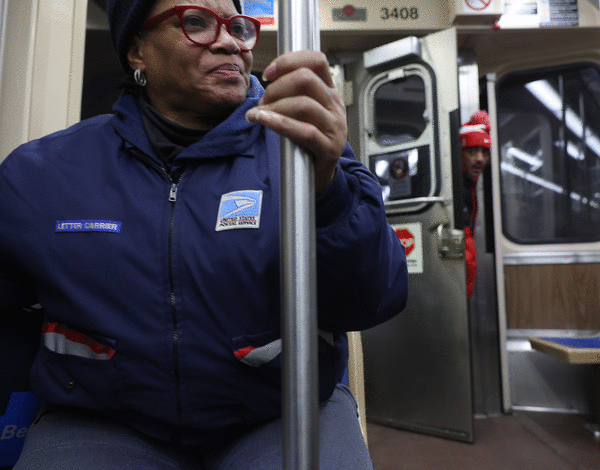
But each time someone boards a CTA bus or train, their chances of becoming a victim of or even witnessing any kind of violent crime that results in serious physical harm to a person — a shooting, a murder — is very small, statistics reviewed by the Tribune show.
The Dec. 23 Pink Line homicide was the eighth killing in the city on the CTA in 2025, according to Chicago Police Department data. CPD recorded six homicides on the system through Dec. 24 last year, but that count doesn’t reflect a mass shooting that killed four people on a Forest Park-bound Blue Line train outside city limits in September 2024.
CTA riders took more than a million bus and train trips on a single average weekday, according to the system’s most recently available ridership data. In other words, CTA riders are far more likely than not to reach their destinations safely.
Violent crime aboard the system is down, mirroring dips across the city and country. CPD data collected through Dec. 21 shows that FBI-classified violent crimes like robberies and shooting incidents on CTA buses, trains and properties have decreased by about 5% between 2024 and 2025. Between 2022 and 2025, data shows there’s been a roughly 10% drop.
But violent crime is still higher overall than it was pre-pandemic, a fact that has vexed transit and city officials for years as they have struggled to make the system safer. In 2019, city data showed there were two homicides on the system in the city limits and five nonfatal shootings.
Last month, a particularly horrific and apparently random attack in which a woman was doused in gasoline and lit on fire while riding the CTA Blue Line in downtown Chicago reanimated conversations about violent crime on the city’s transit system.
The attack, which the woman, 26-year-old Bethany MaGee, survived with severe injuries, alarmed some CTA riders: On a recent Tuesday, some Blue Line commuters brought it up when asked by Tribune reporters if they felt safe while riding the system.
Olivia D’Souza, 23, had heard about the attack and said it made her think more about her own safety on trains and buses, but she still takes public transit every day.
“I just make sure I take the first car,” she said.
President Donald Trump’s administration, which has repeatedly used rhetoric about violent crime as a political cudgel against Democratic-led cities, also seized on the attack, invoking the violence in threats to withhold millions in federal funding from the CTA.
Transit leaders and advocates have at times struggled to reconcile their own desire to improve safety on the CTA with heavy skepticism about the federal government’s approach and intentions.
“It hurts me to say that I’m not happy with the security of our trains and our train stations yet,” CTA board member Roberto Requejo said at the board’s December meeting.
At the same time, he said, he found it “very hard” to “reconcile that the same federal government that is terrorizing, abusing and kidnapping our … residents all across Chicago is the same federal government that shows concern about crime and violence in transit.”
Still, Requejo said, he would “choose to believe” that Federal Transit Administration staff were genuinely concerned about safety and said he’d prefer if they met in person with the CTA rather than sending the agency more letters.
Keith Hill, president of the CTA’s bus operators union, the Amalgamated Transit Union Local 241, said he wasn’t happy with police presence on the CTA, particularly on city buses. “We don’t see police,” he said.
But Hill said he didn’t think the feds’ approach of threatening funding was the answer.
“It doesn’t help the problem,” Hill said. “They should be partnering with CTA, not taking away money.”
‘Gaining back that sense of safety’
The people killed while riding or waiting for CTA transit this year died in a range of different circumstances.
Among them was a 9-year-old boy who fell down the stairs of the Clinton station during an August fight between his stepfather and another man. There was a 25-year-old woman who was stabbed in the back after an argument at the Central Green Line stop in April. There was the man waiting with his girlfriend outside the 35th/Archer Orange Line stop early one September morning.
Most of the criminal activity that takes place on CTA trains, buses or system property is comparatively minor, like when two men boarded a southbound Red Line train at the Wilson stop. They were sitting in the last car when, according to a police report, a man approached them and punched them both in the face. Then the man left the car. Police couldn’t find him in the station.
One of the men, when reached by a Tribune reporter, declined to comment beyond a Reddit post he made two days after the alleged attack, which he described as “literally out of nowhere.”
Besides a bloody nose and a bruised face, the man was physically unharmed. His bigger issue was getting back on the train. Online, he’d asked forum denizens how he could feel safe again.
“What do you do now in terms of moving on and gaining back that sense of safety?”
A Tribune analysis of city crime data showed that of the 4,116 crimes reported on CTA buses, trains, platforms, bus stops or garages through Dec. 10 of this year, the most common report — about 1 in 5 — was for unarmed batteries.
That could include getting slapped, shoved, punched or otherwise hit in a way that doesn’t lead to serious injury.
Batteries on system property have largely returned to their pre-pandemic levels, city data shows. Since CTA ridership is still significantly lower than 2019 volume, that means the average passenger is somewhat more likely to experience a battery than they would have been before COVID.
In a statement, CTA spokesperson Catherine Hosinski said the transit agency had a “multi-layered” safety strategy and that it worked closely with Chicago police to “uphold our longstanding, shared commitment to keeping riders safe.” Hosinski pointed to the Strategic Decision Support Center technology center the CTA opened this year in conjunction with CPD, which it said strengthens “real-time, remote policing capabilities, leveraging the CTA security camera network,” as well as the security “surge” plan announced last week.
“As the operator of one of the nation’s largest transit systems, it is our responsibility to support the efforts of local enforcement through continued investments in technologies and other resources that either help deter acts of crime, and/or aid police in their investigation of crimes that do occur on the system,” Hosinski said.
A CPD spokesperson referred a request for comment to police Superintendent Larry Snelling’s remarks about the recently released surge plan, which Snelling said was a continuation of efforts like the Strategic Decision Support Center.
‘Main way of getting around’
In conversations with the Tribune, CTA riders sometimes noted erratic or antisocial behavior from other passengers when describing why they felt unsafe on the system.
Smoking on trains — which officials have vowed to crack down on — also frequently comes up in conversations about system safety.
“There’s a lot of things that cause people distress, but it’s really hard to untangle what is really a risk to someone’s physical safety,” said Kate Lowe, a professor of urban planning and policy at the University of Illinois Chicago who studies transportation.
Lowe noted, for instance, that the fact homeless people sometimes seek shelter and sleep on the CTA often gets brought up in conversations about the system’s safety.
In fact, the four people killed in the Blue Line shooting last year were sleeping themselves when they were shot.
“Of course, it’s really important for people to feel safe,” Lowe said. “These tragedies get a lot of attention — sometimes they get sensationalized — but the perception of safety may or may not align with the individuals’ actual risk.”
Still, she said, someone doesn’t have to witness violence “to have an uncomfortable transit experience (to) discourage future use.” And things like smoking, for instance, are a public health risk in addition to being a nuisance, she noted.
During a recent Tuesday evening rush hour, Tribune reporters boarded the CTA Blue Line at Clark and Lake in the Loop, stopping to speak with commuters at the busy Jackson station before continuing on another Blue Line train to Forest Park.
In one train car, a smoker tossed a cigarette and let it burn out on the ground. A woman in the car appeared to cover her nose with a scarf. At another point in the commute, a man who was walking between train cars seemed to solicit buyers for marijuana — which was not visible to reporters — saying what he had was “better than the dispensaries.”
Some riders said they generally felt safe on the CTA. Others, in more or less equal measure, said they didn’t. Riders in both groups talked about taking commonsense precautions like switching train cars if the one they were on felt unsafe.
Katelyn Burnett said while she was waiting for a ride from the Forest Park Blue Line station that she tends to see more people she’s “intimidated” by the later it gets in the day.
“There’s people who will scream at you on the train,” the 19-year-old said. “It varies.”
She’ll listen to music, but only with one headphone. She tries to stay off her phone in general. She thinks the buses and trains could be cleaner, and that system authorities could do a better job of enforcing who can get on the buses. But she didn’t think any of the Trump administration’s proposals were going to fix things either.
“Threatening to cut funding isn’t going to solve the problem,” she said. “They’re trying to defund the CTA, but it’s people’s main way of getting around.”
Feds threaten funding
Before Lawrence Reed allegedly set MaGee on fire on the Blue Line, he had been arrested 72 times, federal prosecutors said.
Many of those arrests — including a 2020 attempt at setting the Thompson Center on fire and breaking out the windows on a Blue Line train in 2019 – took place on or around CTA property and attracted minimal public attention. Court records also show Reed has a long history of mental health issues.
Shortly after he was indicted for the arson attack, local authorities connected Reed to a March altercation in which Reed allegedly approached a different CTA Blue Line passenger, tried to sit in her lap until she had to push him off and then tried to kiss her, according to a police report obtained by the Tribune. The report went on to state that Reed picked up a second passenger, slammed him to the ground and attempted to poke his eye out — leading to two more aggravated battery charges.
A few months later, Reed allegedly hit a social worker in the face at a Berwyn hospital so hard she lost consciousness. A judge had denied prosecutors’ request to hold him pending trial and ordered him released on electronic monitoring for that aggravated battery charge. A second judge had loosened the restrictions on his movement — from twice a week to three times — about two months before the alleged attack, court records show.
Cook County State’s Attorney Eileen O’Neill Burke sent a note to county prosecutors shortly after the arson attack noting that the assistant state’s attorney assigned to one of Reed’s earlier battery cases had asked to have Reed detained pending trial. A few weeks later, she said in a Tribune interview she was “going to keep singing this — that electronic monitoring does not keep people safe.”
“We are going to ask for detention if somebody presents a danger,” Burke continued. “If they are not a danger, we don’t ask for detention and I don’t care if they are monitored or not.”
The Trump administration seized on Reed’s prior criminal history in its renewed criticism of Illinois leaders’ approach to violent crime.
“Transit leaders and elected officials who fail to enforce basic law and permit disorder to erode the integrity of their systems are making deliberate choices that endanger riders,” Trump’s Federal Transit Administrator, Marcus Molinaro, wrote in letters this month to Chicago Mayor Brandon Johnson and Illinois Gov. JB Pritzker.
On Dec. 8, the Federal Transit Administration issued a “special directive” demanding the CTA address safety concerns — including by boosting police presence on buses and trains — or risk losing federal dollars. In doing so, the feds invoked the Nov. 17 Blue Line attack and the state’s cashless bail policy, which they described as “deadly.”
It wasn’t the first time the feds had threatened to withhold federal dollars from the CTA over safety issues; Trump’s Transportation Secretary, Sean Duffy, did so in September while simultaneously threatening to withhold funding from Boston’s mass transit system.
Last week, the CTA announced it would quickly roll out a plan to boost the number of police officers on CTA buses and trains, as well as the number of privately contracted K-9 security guards. But the feds blasted that plan as “materially deficient,” saying, among other criticisms, that it failed to target reductions in major assaults against workers and riders for the first three months of next year.
The CTA’s plan, which the agency said was expected to cost $3.5 million, included an increase in the number of Chicago police officers participating in the agency’s “Voluntary Special Employment Program” from an average of 77 to 120 per day. Officers in that program volunteer to patrol the CTA on their days off and serve in addition to the CPD’s public transportation unit, which has 133 officers.
The FTA indicated it believed increasing police hours in that program was insufficient, saying the VSEP program is “one small component of CTA’s overall security strategy that does not meaningfully contribute to an overall increase in security hours across CTA’s system.”
The federal agency demanded the CTA submit a new plan within three months — or lose up to $50 million in federal funding. The CTA has said it will respond to the feds within the required timeline.
In its security plan submitted to the FTA this month, which the Tribune obtained via a Freedom of Information Act request, the agency highlighted various security strategies already in place, including safety “missions” by Chicago police officers on the city’s bus and rail systems.
The CTA also pointed to legislation that has allowed it, as of January this year, to pursue bans against people accused of multiple or serious crimes aboard the CTA. It said it had issued 75 notices of suspension under the program, 36 of which had been approved by an administrative law judge.
The agency did not answer a question about whether it had pursued such a ban for Reed under the new program. However, CPD arrest records indicate that prior to the alleged arson attack, Reed’s most recent arrest anywhere in Chicago was in January 2024, before the program began.
Elected officials and transit leaders have also said new safety measures mandated by the state’s mass transit funding bill, which provides around $1.5 billion for Chicagoland mass transit annually, should help improve safety on transit regionwide.
The law, which will go into effect next June, requires the creation of a regionwide safety task force led by the Cook County sheriff’s office. It also creates a new role of transit ambassador — unarmed workers who will be responsible for general passenger assistance as well connecting with law enforcement and social services to help address safety issues.
Continuing to ride
Blue Line commuter Tali Vittum was reading the popular novel “Tomorrow and Tomorrow and Tomorrow” on her Kindle and jumped when a Tribune reporter approached her for an interview during a recent Tuesday rush hour. She pulled one headphone out of her ear.
Vittum, 23, was headed home to Irving Park that evening. She’d heard about the arson attack and was concerned about it. Like many other passengers, she has her own strategies for staying aware of her surroundings, like not wearing noise-canceling headphones and where she stands on train cars. But in general, Vittum said she generally feels safe on trains and buses, which she’s taken alone since she was a young teenager.
“Not that things don’t happen,” she said. “But I feel like we get turned into an example a lot.”
--------
—Chicago Tribune’s Madeline Buckley contributed to this story.
____
©2025 Chicago Tribune. Visit at chicagotribune.com. Distributed by Tribune Content Agency, LLC.





Comments