Judge halts DHS policy on oversight visits to ICE detention facilities
Published in News & Features
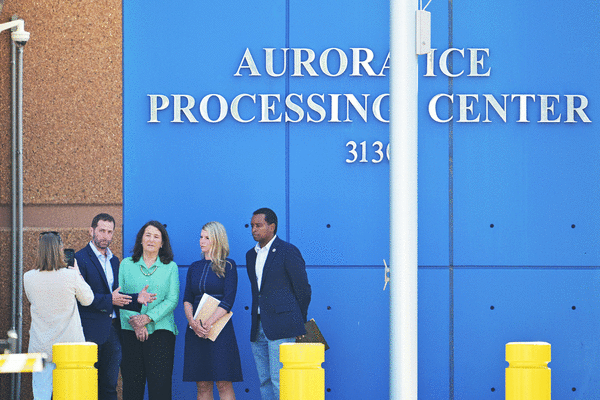
WASHINGTON — A federal judge on Wednesday temporarily blocked Department of Homeland Security guidance that placed new limits on members of Congress seeking to visit and inspect immigration detention facilities.
Judge Jia M. Cobb of the U.S. District Court for the District of Colombia sided with Democratic lawmakers, in an opinion that found the Trump administration policy that effectively required members of Congress to give a seven-day notice before making a visit is likely “contrary to law and in excess of DHS’s statutory authority.”
“Congress not only prohibited DHS and ICE from preventing Members of Congress from entering covered ICE facilities upon request, but also from making temporary modifications that would alter what a visiting Member sees when they visit,” Cobb wrote, referring to Immigration and Customs Enforcement.
DHS announced the new policy in June amid a flurry of high-profile clashes and denials of entry as Democratic members of Congress and other officials sought to visit facilities. The new guidance, in addition to requiring a seven-day notice for congressional visits, gave immigration officials the power to end a visit if the protocol is not followed.
Twelve members of Congress sued in July, contending they were unlawfully prohibited from touring immigration detention facilities as part of their oversight duties. They argued that for years Congress has included provisions in spending law requiring that DHS allow congressional access to its facilities.
The plaintiffs include Rep. Joe Neguse of Colorado; Rep. Adriano Espaillat of New York, the Congressional Hispanic Caucus chair; Rep. Bennie Thompson of Mississippi, the top Democrat on the House Homeland Security Committee; and Rep. Jamie Raskin of Maryland, the top Democrat on the House Judiciary Committee.
In a joint statement, the lawmakers hailed the judge’s decision as a win that would enable them to “conduct essential congressional oversight on behalf of the American people.”
“It reinforces the rule of law and reminds the administration that oversight is not optional,” the lawmakers said. “Real-time, on-the-ground visits to immigration detention facilities help prevent abuses and ensure transparency.”
Lawmakers had contended the DHS policy was in violation of Section 527 of federal appropriations law, which spells out the authority for members of Congress to make unannounced visits to immigration detention facilities, and that the protocol was arbitrary and capricious under the Administrative Procedure Act.
Cobb rejected several arguments the Trump administration made in favor of the DHS guidance, including a part of Section 527 that requires staffers working for member of Congress to give advance notice for visitations. That language doesn’t apply to lawmakers themselves, Cobb wrote, because that interpretation would be inconsistent with other portions of the law.
“That the statute appears to carve out the permissibility of an advance notice requirement for congressional employees while saying nothing about Members of Congress further supports Plaintiffs’ reading of the statute that such advance notice requirements are not permissible for Members of Congress,” Cobb wrote.
The lawsuit was paused briefly during the government shutdown this fall when the U.S. government informed the court the appropriations law which included Section 527 had expired. The case, however, resumed when lawmakers came to an agreement on continuing to the fund the government.
_____
©2025 CQ-Roll Call, Inc. Visit at rollcall.com. Distributed by Tribune Content Agency, LLC.






Comments