Do you have a frame around your Florida license plate? Note a change in the law
Published in News & Features
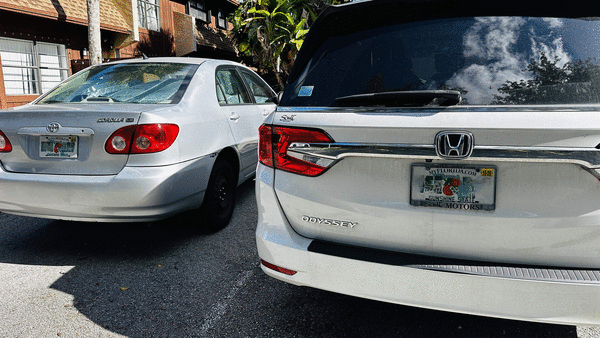
MIAMI — Is your license plate frame illegal in Florida?
That’s the question drivers have been confused about since a revised law took effect Oct. 1.
The law isn’t new. The penalties are.
But drivers are jamming social media wondering whether they should remove their car dealer or sports team frames, or leave them alone. There are plenty of misinformation and misguided memes, too.
“I was worried my license plate cover ... was going to have to be taken off,” posted Ally Blake, a Florida meteorologist who also reports on traffic issues.
Even law enforcement officers have been confused.
All that has led the Florida Department of Highway Safety and Motor Vehicles to issue a memo on Dec. 12 clarifying the law.
The short answer: License plate frames are illegal only if they obscure identifying characters on the plate. Also illegal: sliding panels or other shrouding that hides license plates from plate readers at tolls or traffic checks.
“License plate frames are not prohibited as long as they do not obstruct the alphanumeric plate number or the registration validation decal in the upper right corner,” said Miami-Dade Tax Collector Dariel Fernandez, whose office issues plates to drivers and vehicle owners.
But if you do have an illegal plate cover, you can face stiffer penalties.
Here’s what to know, according to the Florida agency’s guidelines:
Are license plate frames legal or illegal in Florida?
License plate frames aren’t prohibited in Florida as long as the frame does not obscure the following characteristics of a license plate:
•The alphanumeric plate identifier — in other words, your license plate numerals and/or letters.
•The decal located in the top right-hand corner of your license plate. That’s the yellow annual or biannual registration sticker you place at the top right corner after renewal.
•In the Department of Highway Safety & Motor Vehicles’ language it “does not consider the information on the bottom of the plate to be a primary feature of the plate. A plate frame that impinges on the information at the top of the plate is permissible, as long as law enforcement is able to identify the state that issued the plate.”
•Lettering atop the plate usually reads “MyFlorida.Com” and at the bottom reads “Sunshine State.” That lettering is not considered “primary information” and a frame can cover it. But note: The registration sticker on the right side of the plate is nearly level with the “MyFlorida.Com lettering. Keep that in mind if you are partially or fully obscuring “MyFlorida.Com.” If the frame cuts the visibility of the sticker, you’re breaking the law.
What you can’t have on your vehicle
The city of Miramar posted a meme to Facebook Monday to emphasize the Florida statute’s prohibited items. Do not have these things on your plate:
•“Tinted, smoked, or clear license plate covers.
•“Frames, decals, bolts, or accessories that block or obscure letters, numbers, decals.
•“Sprays, coatings, or reflective materials applied to the plate. Any device or item designed to obscure, disguise, or interfere with license plate visibility, including those marketed to defeat toll readers or traffic cameras.”
The Florida House bill listed illuminating or reflective devices that are illegal. These include “any lamp or device showing or displaying a red, red and white, or blue light” onto the plate. Basically: Don’t pretend to be a law enforcement officer to stop another vehicle. That’s a third-degree felony, not just a felony misdemeanor. Just don’t add lights to your plate.
Mechanisms that flip, hide or switch between plates should not be installed. If you make, sell or install these devices you’re in bigger trouble.
What are the new penalties and fines?
All of the listed infractions existed before October. Only the penalties have changed.
Here are the changes:
•Having a frame that obscures your license plate’s primary featuresis now a second-degree misdemeanor. Before Oct. 1, it was a noncriminal traffic infraction.
•The penalty fine is now up to $500. It used to be a warning or “fix-it” ticket or a small fine.
•Jail time can be up to 60 days after the bill’s October enforcement. No jail time before.
•Selling or manufacturing or distributing obscuring devices like license flippers or screens is now a first-degree misdemeanor that can yield a year in jail and a $1,000 fine.
•Felony upgrade if you use a license obscuring device while committing a crime or fleeing a crime. That’s a third-degree felony carrying up to five years in prison and a $5,000 fine.
What to do if you have doubts
If in doubt about your license plate frame, Doral Police Chief Edwin Lopez told NBC 6 on Monday just to remove it. That’s his advice.
“It’s quite frankly, very simple as that. It’s a recommendation that I’ve given to my parents,” he said. “I simply told them to remove the license plate frame from the vehicle. It’s just simpler that way. Instead of getting into a back and forth as to if some items are obscured and some are blocked, and some are not.”
©2025 Miami Herald. Visit at miamiherald.com. Distributed by Tribune Content Agency, LLC.






Comments