Miami's Radio Mambí going off the air in a tough year for Spanish-language media
Published in News & Features
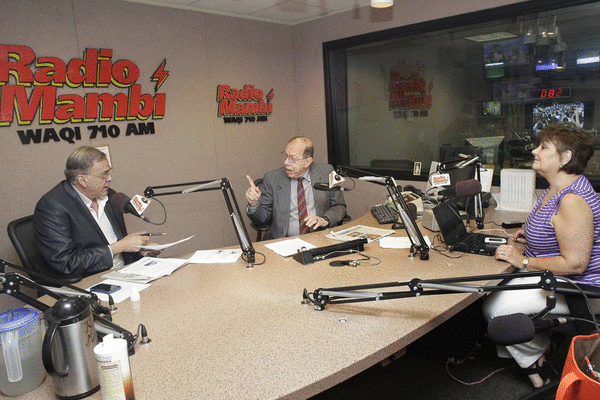
MIAMI — Radio Mambí — the iconic Miami station long considered a pillar of the Cuban exile community — will go off the air as we know it on Friday at 11:59 p.m. For more than four decades, it served as a gathering place for news about Miami and Cuba, and as a forum where listeners called in to share their problems, complaints, sorrows and joys.
The station, WAQI 710 AM, will shift to programming archived shows and music, and the journalists and staff behind its current programming have lost their jobs, including Jorge Luis Sánchez Grass, José Luis Nápoles, José Carlucho, Lilliet Rodríguez and radio grande dame Lucy Pereda.
Since rumors began circulating about Radio Mambí’s closure, memories and tributes have poured in for the station that, since its founding in 1985, was inseparable from the voice of the late broadcaster Armando Pérez-Roura — famous for reminding Miami listeners they were tuned to “Radio Mambí la Grande.” Another of the station’s icons was late journalist Agustín Tamargo and his unforgettable sign-off: “Cuba primero, Cuba después y Cuba siempre.” And the overnight programs hosted by Martha Flores and Martha Casañas — true queens of the night who made listeners feel like close friends — were tent poles of the station.
“Cuban radio was for me more than a source of news, it was a school,” writer Luis de la Paz told el Nuevo Herald. “Listening to La Cubanísima, Cadena Azul and Mambí, I learned part of Cuba’s history that the Castro regime tried to hide from those of us who grew up under it. Through radio, I understood what the Republic contributed to the Cuban nation and I learned about the mistakes that brought Fidel Castro to power.”
For many, Radio Mambí’s decline was “a chronicle of a death foretold” since Latino Media Network, or LMN, bought it in 2022. The company, partly financed by billionaire George Soros, acquired 18 stations in U.S. Hispanic markets from TelevisaUnivision as part of a $60 million deal.
Radio Mambí’s exit comes during a brutal year for Miami’s Spanish-language media, which saw the loss of América TeVé in May. The Hialeah Gardens–based station had high-rated shows by talent like Cuban journalist Juan Manuel Cao, who later started his own YouTube show.
In July, WQBA 1140 AM, traditionally known as La Cubanísima, was closed — only two years after it was sold to Latin Media Network. The station had promised to make improvements to its news and analysis programs, as journalist Oscar Haza announced in 2024 when the station entered its new phase: “We want to rescue professional radio.”
Journalist José Alfonso Almora, who lost his job when WQBA shut down in July, lamented Radio Mambí going off the air.
“Another emblematic station like WQBA is lost,” Almora said. “Radio Mambí was the political platform of Republicanism for three decades, and after the Trump era it now loses a civil political platform.”
Mike Sena, general manager of Radio Mambí, recalled the station’s work over four decades. “It has been a meeting point for South Florida and for everyone committed to the ideal of a free Cuba,” he said. “Our microphones welcomed presidents, governors, mayors, dissidents and political prisoners, cultural icons and community voices. We were with Miami during hurricanes and historic moments.”
Sena said Radio Mambí will remain the Spanish home of the Miami Heat and the Miami Marlins. He attributed the station’s closure to changes in audience habits and the media industry.
“Like our beautiful city, Radio Mambí, its audience and the media industry are evolving rapidly, which presents financial challenges for many in the market,” he said.
These changes reflect not only economic and structural challenges but also a deep transformation in how Miami’s Hispanic community consumes content, stays informed and connects with its cultural roots, the station said in a statement to el Nuevo Herald.
For writer Luis de la Paz, “each station closure empowers social networks and so-called influencers and content creators, who in many cases lack credibility.”
La Poderosa, another Miami station that absorbed Mambí personalities such as Ninoska Pérez Castellón after Mambí’s sale to Latino Media Network, canceled part of its programming and laid off talent, producers and technicians on Aug. 8. Pérez Castellón keeps her show on La Poderosa, though the station lost some of its reach when it moved from 670 AM to 990 AM, which has less coverage in South Florida.
Political analyst Fernand Amandi lamented Radio Mambí’s closure as he did WQBA’s months earlier. “It’s a big blow, whether we like the station’s political leanings or not,” said Amandi, who called Radio Mambí “a classic, legendary forum where the Spanish-speaking community went to the radio to understand and discuss local, national and international issues.”
“The saddest part is that nothing is replacing it,” Amandi noted, crediting Radio Mambí and other stations as spaces where Cuban exiles “had voice and representation before having influence or political power.”
Radio was instrumental to creating political power and representation of the community, Amandi said, adding that without radio, many politicians would not have reached important national political positions, becoming trailblazers for Hispanics.
The analyst said he does not believe the closing of the station signals the waning political power of Cuban exiles. “It’s poor management of the station,” he said, “which instead of offering a balanced, information-based lineup that included the community’s full political spectrum, became just another outlet and failed to deliver what was promised when the station was acquired.”
Film critic Alejandro Ríos, who said he appreciated how Pérez-Roura and Tamargo welcomed him when he arrived in exile on Mambí’s airwaves, said the station had been losing its connection to the community. He said that changing radio personalities disrupted tradition and continuity.
Ríos, however, is optimistic that social media will not replace the habit of getting in your car and turning on the radio.
“To go to YouTube, you have to look for it, but turning on the radio and hearing your favorite commentator — that has no substitute,” he said.
©2025 Miami Herald. Visit miamiherald.com. Distributed by Tribune Content Agency, LLC.






Comments