US seizes oil tanker off Venezuela as Trump expands military pressure on Maduro
Published in News & Features
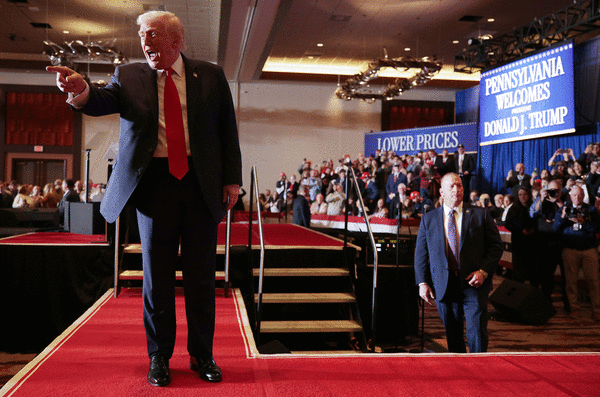
U.S. forces seized an oil tanker off the coast of Venezuela, President Donald Trump said Wednesday, in the latest escalation in a widening U.S. campaign of military and law-enforcement pressure on the Nicolás Maduro regime.
Speaking to reporters at the White House, Trump described the vessel as “a large tanker, very large, largest one ever seized, actually,” but offered no further details. He hinted more actions could follow, saying only that “other things are happening” and that it had been “an interesting day.”
According to the Associated Press, the seizure was led by the U.S Coast Guard and supported by the Navy, according to a U.S. official who was not authorized to comment publicly and spoke on the condition of anonymity. The official added that the seizure was conducted under U.S. law enforcement authority.
The move comes amid far-reaching U.S. sanctions on Venezuela’s state oil company, Petróleos de Venezuela, S.A. (PDVSA), which have sharply limited its ability to operate in global markets. Under those measures, the United States bars maritime companies, insurers, banks and other service providers from facilitating Venezuelan oil exports.
Confirming the seizure on social media, Attorney General Pam Bondi said the tanker seized on Tuesday had long been sanctioned for its role in transporting sanctioned oil from Venezuela and Iran. The operation was carried out by the Federal Bureau of Investigation, Homeland Security Investigations, and the United States Coast Guard, with support from the Department of War, she said on her X account.
Bondi added that the tanker had been sanctioned for several years due to its involvement in an illicit oil shipping network that aided foreign terrorist organizations. “This seizure, completed off the coast of Venezuela, was conducted safely and securely,” she wrote, noting that the U.S. investigation, in collaboration with the Department of Homeland Security, continues to prevent the transport of sanctioned oil.
Her comments were accompanied by a video showing what appeared to be armed special forces rappelling onto the ship from a helicopter and later taking control of the vessel.
The tanker seizure comes amid rising tensions between Washington and Caracas as the Trump administration expands its military footprint across the Caribbean. The buildup is part of a sweeping operation targeting Latin American drug cartels — a mission that has become a central pillar of Trump’s foreign policy.
At the heart of the campaign is Venezuela’s so-called Cartel de los Soles, which the Justice Department claims is led by Maduro and top members of his inner circle.
In recent weeks, the Pentagon has deployed additional air and naval assets to the region, including the USS Gerald R. Ford aircraft carrier, which hosts multiple fighter squadrons, and guided-missile destroyers. The expansion coincides with a series of U.S. strikes on boats in the Caribbean and eastern Pacific that officials say were ferrying narcotics for transnational criminal networks.
Trump has repeatedly defended the strikes by casting the U.S. as engaged in an “armed conflict” with drug cartels operating near Venezuelan waters. In an interview published Tuesday by Politico, he warned that Maduro’s “days are numbered,” pointedly refusing to rule out the use of American troops on Venezuelan soil.
The increasingly aggressive posture builds on years of legal pressure against Maduro. In 2020, the Justice Department charged him with narcoterrorism, and more than a dozen senior Venezuelan officials were indicted as well. The State Department later offered a $50 million reward for Maduro — the highest bounty ever placed on a sitting head of state.
U.S. officials say the latest maritime operation is part of a broader strategy to degrade the cartel’s logistical networks and tighten the squeeze on Maduro’s government. Last week, Trump convened senior national security officials in the Oval Office to outline the next phase of the campaign — one he has said will extend into Venezuelan territory.
Maduro, meanwhile, has shown no public sign of backing down. Instead, he has sought to project defiance, accusing Washington of psychological warfare.
“We have lived through 22 weeks of aggression that can be described as psychological terrorism,” he said recently outside the Miraflores presidential palace, claiming that “more than 94% of public opinion rejects and repudiates the imperialist military threat.”
_____
©2025 Miami Herald. Visit miamiherald.com. Distributed by Tribune Content Agency, LLC.





Comments