After California lawsuits, Trump administration pauses plan to divert billions of dollars from homeless housing
Published in News & Features
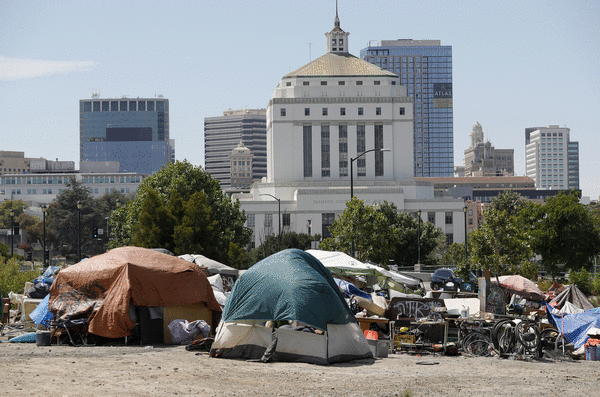
The Trump administration has temporarily paused a plan to divert billions of dollars in homelessness spending away from permanent housing, a move that critics of the plan, including a Silicon Valley congressman, said is a win for local efforts to fight homelessness and prevent formerly unhoused Californians from being forced back to the street.
The administration had sought to redirect the money toward transitional housing and outreach efforts, prioritizing programs that impose work requirements, mandate addiction or mental health treatment and help police close encampments. But on Monday, federal housing officials abruptly withdrew a notice to local governments to apply for the grant funding.
The pause came the same day as a court hearing on two lawsuits challenging the funding change: one from a coalition of 21 states, including California, and another from 11 local governments and nonprofits, including Santa Clara County. In a court filing, HUD officials said the move was “to assess the issues raised by Plaintiffs in their suits and to fashion a revised” notice of funding opportunity, according to Politico.
Outside of court documents, the U.S. Department of Housing and Urban Development has offered few details about why it chose to rescind the notice of $3.9 billion in Continuum of Care funding, the primary source of federal homelessness dollars. The agency did not immediately respond to a request for more information.
The two lawsuits challenge a HUD requirement announced last month that no more than 30% of Continuum of Care funding can be used for permanent housing, freeing up more money for transitional housing and sober-living programs. In California, 87% of those funds, or about $300 million, currently go toward long-term homeless housing sites and rental assistance programs.
The lawsuits contend the funding changes would be illegal because they were made without congressional authorization and are “not supported by evidence or reason.” California officials said the administration’s plans would slash money for “proven strategies to address homelessness.”
The withdrawal of the funding notice ahead of Monday’s court hearing came as a surprise to U.S. District Judge Mary S. McElroy, Politico reported.
“This sort of haphazard approach to administrative law is the problem,” said McElroy, who was nominated by President Donald Trump after an initial nomination by former President Barack Obama expired.
San Jose Rep. Sam Liccardo, who wrote a letter to HUD signed by 32 fellow congressional Democrats opposing the funding shift, said the temporary withdrawal will directly benefit families who rely on federally funded supportive housing programs, even though it remained unclear how the administration might update the funding notice.
“We must keep treating our housing crisis like the crisis it is,” Liccardo said in a statement. “Keeping this program intact is a critical step in the right direction, and I’ll continue holding this administration accountable to protect proven solutions.”
The initial news of the funding change has sent homelessness service nonprofits in California scrambling to understand its impact on their programs. Providers worry that, without finding ways to fill potential funding gaps, they may be forced to close housing sites and end rental aid efforts, leaving thousands without a crucial lifeline across the state’s staggeringly unaffordable rental markets.
Administration officials argue that shifting away from permanent supportive housing and voluntary services is necessary to reverse what they describe as decades of failed polices that have led to rising homeless populations and an explosion in dangerous encampments. They contend that federal homelessness funding has gone to support unsafe housing sites where people frequently use drugs without getting the help they need — a claim homelessness services providers maintain is exaggerated.
“Our philosophy for addressing the homelessness crisis will now define success not by dollars spent or housing units filled, but by how many people achieve long-term self-sufficiency and recovery,” HUD Secretary Scott Turner said in a statement announcing the initial funding changes.
In California, homelessness has surged 62% over the past decade to an estimated 187,000 people, though some large counties, including Contra Costa, have reported encouraging declines this year. The Bay Area’s estimated homeless population reached 38,891 last year, a 46% spike since 2015, as housing costs have also soared over the last decade.
_____
©2025 MediaNews Group, Inc. Visit at mercurynews.com. Distributed by Tribune Content Agency, LLC.






Comments