Cuba's former economy minister, accused of spying, is sentenced to life in prison
Published in News & Features
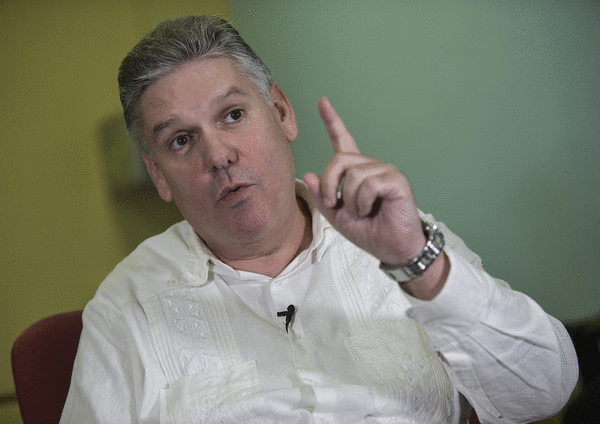
In a rare high-profile case, Cuba’s former vice prime minister and minister of economy, Alejandro Gil, was sentenced to life in prison on charges of espionage, the People’s Supreme Court announced in a harshly worded statement on Monday.
In a first trial that took place Nov. 11-13, Gil was found guilty of several crimes including espionage, bribery, “acts to the detriment of economic activity or contracting,” theft and damage to official documents, and violating rules for handling classified information, “the latter of a continuous nature,” the statement published in the country’s main daily, Granma, said.
In a later trial, which was not previously disclosed, he received a separate sentence of 20 years in prison for additional bribery charges, falsification of public documents, influence peddling and tax evasion, “both of a continuous nature.”
Gil, a minister close to the country’s handpicked president, Miguel Díaz-Canel, was suddenly dismissed in February 2024 and arrested days later. In a vague statement a month later, Díaz-Canel suggested Gil was the subject of a corruption investigation. But in early November, after a year and a half of silence on the case, the Office of the Attorney General announced he faced espionage charges.
The statement in Granma justified the heavy-handed sentences, accusing Gil of treason and corrupt acts. “Betrayal of the Homeland is the most serious of crimes and whoever commits it is subject to the most severe sanctions,” the statement said.
Gil, 61, “took advantage of the powers granted by the responsibilities he assumed to obtain personal benefits, receiving money from foreign firms and bribing other public officials to legalize the acquisition of goods,” the court said. “He deceived the leadership of the country and the people he represented, creating damage to the economy.”
There was little detail, however, about the espionage charges. The court only mentioned that he failed to follow rules for handling classified information and that he “stole” the information, “damaged it and finally made it available to the enemy’s services.”
The court did not name the country he allegedly spied for but Cuban authorities frequently refer to the United States as “the enemy.” Gil’s sister, María Victoria Gil, a former Cuban television host residing in Spain, denied her brother was a spy in an interview with the U.S. government outlet Marti Noticias. She said the government prosecutor had accused her brother of spying for the CIA.
Before the espionage trial, Gil’s daughter, Laura María Gil, asked for a public trial and the disclosure of details about the espionage charges. As a result, she was not allowed to attend the hearings.
The truth of the matter will likely remain unknown, at least for now, as Cuba’s legal system provides little room for appealing sentences, the media is controlled by the state, most legal records cannot be requested by the public and there are no organizations capable of investigating the case independently.
Though in recent years several ministers have been dismissed or demoted with little explanation, the prosecution of Gil and the serious accusations he faced have rarely been used by Cuban authorities to punish former officials. Other high profile figures that fell from grace, like former vice president Carlos Lage and former foreign minister Felipe Pérez, have not gone to prison and have been allowed to live and work on the island. Not since the infamous trial of Gen. Arnaldo Ochoa and other high-ranking officials, who were accused of narcotrafficking in 1989 and later executed by firing squad or given long prison sentences, have Cuban authorities so forcefully came out publicly to make an example of one of their own.
Gil’s friendship with Díaz-Canel, who oversaw his doctoral dissertation, raises questions about the political standing of Cuba’s handpicked president, whose term officially ends in 2028 and who is seen as a placeholder figure for Raúl Castro, the retired general who still rules the island, and the Cuban military. Four days after Gil’s dismissal and before he was arrested last year, Díaz-Canel congratulated Gil on his birthday and sent him “a hug” in a publication on X, suggesting the Cuban leader might not have been privy to the full details of the case the Interior Ministry was building against Gil. But according to Gil’s sister, Díaz-Canel testified in the trials against the disgraced minister.
Gil’s Ph.D. dissertation’s title was “Methodology for the Management of the National Economic and Social Development Plan of Cuba.” Whatever method he developed did not seem to work, as the former economy minister became the face of disastrous policies that further dragged the country into its current economic collapse, including a botched monetary reform that fueled inflation.
©2025 Miami Herald. Visit at miamiherald.com. Distributed by Tribune Content Agency, LLC.





Comments