In its time left, this prison is experimenting with a new housing model
Published in News & Features


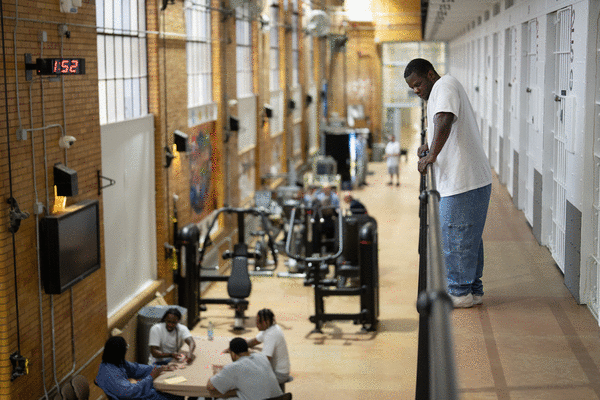





BAYPORT, Minn. — The B-East cell hall at Stillwater prison was once a place of echoing lockdowns and razor-edged tension.
“Some things that’ll never leave,” said Lt. Sam Marks, recalling the stabbings, self-harm and overdoses that reverberated through the four tiers of steel and concrete.
But since the Department of Corrections began the process of closing the prison this fall, an experiment has taken root in the newly opened space.
Inside, incarcerated people tend herb gardens, line up for “shape-ups” in a resident-run barbershop, debate books in a discussion group, and help run a prison tattoo shop.
The transformed space is an “earned living unit,” or ELU, that trades privileges for accountability. Since the unit opened about two months ago, multiple staff and residents said, the unit has not faced a lockdown.
“The interaction between inmates and the staff has changed, a complete 180,” Marks said. “We’re building something together.”
DOC Commissioner Paul Schnell said the department will use Stillwater’s remaining years to refine the ELU model here and expand it to other facilities. A parallel unit at Faribault prison launched around the same time.
What the unit looks like — and how it works
The ELU sits inside Stillwater’s historic cellblocks, but the daily rhythm is different. Men move freely between units, work, the gym and other spaces during the day, residents said. The old black line in the middle of the main corridor — which incarcerated people were once forbidden to cross — is gone.
The unit offers “more freedom, more movement, more opportunity and access to other commissary options,” Schnell said. Eligibility is based on an application and past behavior.
Most cells are single-occupancy; some residents receive a second cell for study or projects. The block now includes air fryers, pizza ovens, weight equipment, video games and hobby spaces.
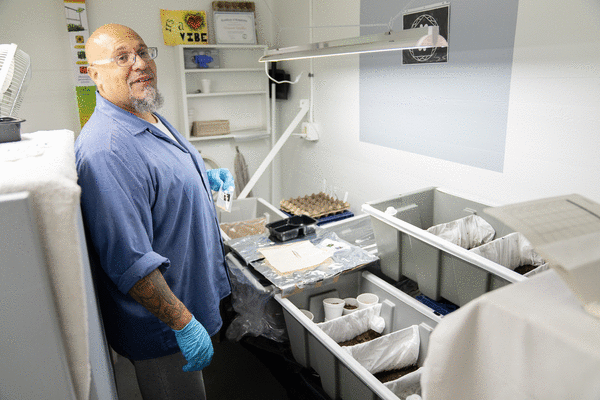
Damon DiMartino, 50, convicted of promoting prostitution, said he spends much of his time in that spare cell, where he grows peppers and four types of basil under lights. He used to sneak dandelions and other weeds from the yard back to his cell to grow and was punished for it.
“I can’t believe they’re letting us do this,” he said as he tended to plants. DiMartino and other inmates use the herbs in homemade lasagna and pizza.
“When there’s nothing to do, I just kind of sit in here for a moment,” DiMartino said. “This is about as free as I’m going to get for a while — a few more years anyway."
Incarcerated people can also decorate their cells as they wish. Brandon Cox, 39, who is serving a life sentence for a conviction of first-degree murder, asked tattoo artist Daniel Gonzalez to paint murals on his walls, including one of his son.
Inmates described town halls, unit mission statements and shared standards that, staff said, are sometimes “more robust” than DOC rules.
The climate shift has been immediate.
“Being here for almost two months and never seeing a fight,” Cox said. “You can’t be in prison and experience that. It shows that the guys are really here for the program, and the guys are really here to better themselves and uplift everybody.”
Keith Grube, 59, serving a life sentence for first-degree murder, has cycled through Rush City, Moose Lake and Lino Lakes. He called Stillwater’s ELU “hands down” the best.
“This is a prison only if you want to act like a prisoner,” he said. “If you want to act like this is a community, then this is a community.”
Questions as transfers ripple across the system
Staff and residents acknowledged the human side of Stillwater’s transition — friends transferred statewide, programs paused, longtime officers reassigned.
And also a recurring concern: whether concentrating highly motivated residents in the Stillwater ELU and transferring out “heavy hitters,” as Marks described it, pushes troubled dynamics elsewhere in the state. The Stillwater units before the changes shifted prisoners averaged a lockdown a quarter, the DOC said.
The DOC transferred 262 people from Stillwater to Rush City, now operating at about 94% capacity, according to DOC data. Overcrowding can increase violence, Schnell said, citing the recent death of Stephen Washington after an alleged altercation with his cellmate and the August assault of four correctional officers at Rush City.
Schnell said the department is tracking incidents closely but emphasized that the ELU is built around risk-based placement, not displacement.
Inmates must apply to the unit. In the two months since they opened, three inmates at Stillwater and three in Faribault have been removed from the units, according to the DOC.
So far, he said, DOC has found no evidence that Stillwater’s phased closure has caused new violence at other prisons.
“The reality is, anytime you have higher populations, higher numbers of people, you’re going to have an increase in problems,” Schnell said.
He said he remains confident prisons are adequately staffed. Staffing levels across the entire system are higher now than in 2019, when the prison population was more than 1,000 people larger.
A tattoo parlor and barber shop
The self-governance ethos extends to programs that inmates built themselves, which are now part of the ELU.
Stillwater’s two-year-old tattoo program operates like an outside apprenticeship, overseen by a full-time DOC administrator. Apprentices practice on synthetic skin, complete sanitation courses and test for licensure through the Minnesota Department of Health.
Two early apprentices paroled this year and were hired as tattoo artists right away, staff member Justin Jiminez said. One placed second at a tattoo convention.
Licenses for the two artists, Daniel Gonzalez, 28, and Courtney Ocegueda, 29, hang on the wall. Practice skins show crisp linework and color studies. Staff say DOC-permitted tattooing reduces hepatitis transmission behind bars.
In a chair, Gonzalez — serving time for second-degree murder and assault — layered color into a multi-session dragon tattoo across Matthew Fahey’s back. Fahey, 40, imprisoned for first-degree criminal sexual conduct, criminal sexual predatory conduct and kidnapping, sat patiently through his fifth session.
“I’ve always wanted to be a tattoo artist, but I never thought it was possible,” Gonzalez said. “Sometimes it can be expensive.”
Residents also built a barbershop they named Street Cuts. Joe Soltis, 69, serving a life sentence for first-degree murder, had pushed for a shop for decades. After the ELU launched, residents converted part of a recreation room into a full-service barbershop, complete with graffiti lettering and paint-splatter floors.
Soltis hopes the unit will eventually start an accredited barber school.
What’s changed systemwide — and what hasn’t
Earlier this year, the Legislature ordered Stillwater to close by June 2029. Already, 60% of Stillwater’s population has been transferred, and the remaining inmates are in the ELU, substance abuse or restrictive housing units.
Schnell said the Stillwater closing so far has met budget targets, with total cuts reaching $48 million by 2029. The 111-year-old facility has an estimated $180 million in deferred maintenance.
Schnell said the prison population statewide is about 8,300, down from about 10,000 in 2019, allowing the DOC to absorb Stillwater’s residents.
Planned capacity at Stillwater during the wind-down is about 550, down from roughly 1,180 before the closure decision.
Long-term, DOC is considering expansions at other prisons and may seek bonding for improvements at St. Cloud, which has significant infrastructure needs.
Incentive-based programs in Maine and Missouri inspired the ELU. Maine officials report declines in assaults and disciplinary actions after adopting similar models.
A decommissioning study is underway to determine Stillwater’s future. Parts of the site are on the National Register of Historic Places; many shuttered prisons nationally have been converted to mixed-use housing, Schnell noted, though any reuse project would need to resolve matters of hazardous materials and active bonds.
Inside Stillwater, residents say the transformation is already tangible.
“The vibe’s a lot better,” said Henry Patterson, 51, serving a life sentence for first-degree murder, who works in the barbershop. “It isn’t as stressful — and they let you be a man.”
©2025 The Minnesota Star Tribune. Visit at startribune.com. Distributed by Tribune Content Agency, LLC.






Comments