Haiti's anti-corruption agency accuses former president Martelly of lying about assets
Published in News & Features
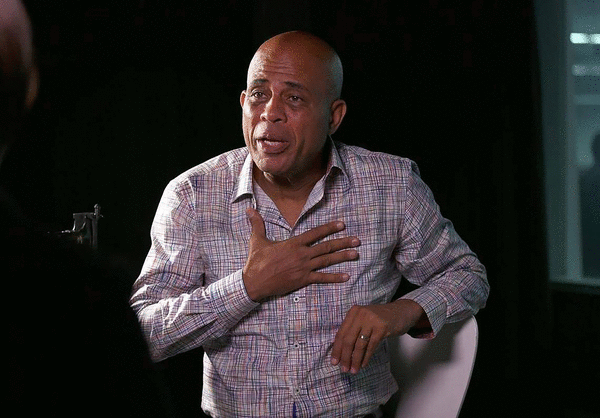
Haiti’s corruption investigators are calling for criminal charges against former President Michel Martelly, accusing him of filing false statements about his wealth.
A review of Martelly’s asset disclosures covering the period from his election in 2011 to his financial declaration two years after leaving office in 2016 found major inconsistencies, omissions and unexplained income, investigators said. The inquiry examined the former president’s paperwork and bank accounts as well as those of his wife, Sophia Saint-Rémy Martelly, a U.S. citizen.
The commission that conducted the investigation “is able to confirm that Mr. Martelly’s entry and exit asset declarations are incomplete and false,” investigators said.
The Miami Herald reached out to Martelly’s lawyer, who did not respond by the time this story was published.
The allegations emerged from a wide-ranging investigation by Haiti’s Anti-Corruption Unit, which has sought to uncover the source of Martelly’s assets. Investigators culled through bank accounts, vehicle registrations and property records in Haiti and analyzed the couple’s asset declarations.
They noted that while he claimed he had only six bank accounts in Haiti, they found 17 belonging to him, his wife and their charitable foundation. Investigators also noted that among his assets are real estate holdings dating back to 1992, before he ran for president, worth over $1 million.
Investigators say they found untraceable wealth, incomplete documentation and declarations that they said did not align with Martelly’s official salary, which he claimed never exceeded about $6,000 a month while in office. After leaving office, Martelly, a former musician who lives in Miami, claimed his family’s consolidated wealth exceeded $718,000. He had previously said their wealth was $370,400.
“Although Michel Joseph Martelly is known by his stage name Sweet Micky, no documentary evidence confirms the continuation of artistic activities during his presidential term,” the investigators said in one of many entries raising questions about his income. “Similarly, his speaking fees are not supported by any documentation. This situation therefore raises doubts about the true source of these funds.”
They also highlighted “a major discrepancy” concerning Sophia Martelly’s income, noting that while her husband said she had a salary of $60,000 a year, the couple failed to mention the money she was being paid as an adviser during his tumultuous presidency. The regular payments she received from the Ministry of Economy and Finance from May 2011 to February 2016, were not declared and should have been included in Martelly’s official declaration, the report said.
They also note that “a significant portion of the income declared by” Michel Martelly was in U.S. dollars, but there was no mention of the sources of these funds, payment flows, supporting documents, or corresponding bank transactions.
“This lack of traceability violates the obligations stipulated by Haitian legislation regarding money laundering and the financing of illicit activities, which requires clear documentation concerning the origin of foreign currency funds,” the report notes.
The report was forwarded Monday to the offices of the chief prosecutor in Port-au-Prince. Investigators say Martelly’s failure to disclose all property he owns, including vehicles that suddenly went missing from one document to the next, is a criminal offense under Haitian law.
This is the first time a Haitian government agency has publicly scrutinized Martelly, who is under sanctions by the U.S. and Canada and has been accused of ties to armed gangs by a United Nations panel. The U.S. State Department has accused Martelly of abusing “his influence to facilitate drug trafficking” and sponsoring “multiple Haiti-based gangs.”
Martelly facilitated the trafficking of drugs, including cocaine, destined for the U.S., the Treasury Department said. He is also accused of drug-money laundering, working with Haitian drug traffickers and sponsoring several Haitian gangs.
Whether the claims against Martelly will carry any legal weight in Haiti, where few officials are held to account for alleged wrongdoing, remains unclear. Politically, however, the accusations threaten to weaken him and his PHTK political party as the country’s political forces prepare for elections in the coming year.
Martelly has continued to maintain a prominent profile in Haitian politics. Elected to the presidency after the devastating 2010 earthquake in a controversial vote, he was dogged by accusations of involvement in gang violence, drug trafficking and the embezzlement of nearly $2 billion in aid from a Venezuelan oil program.
Over the weekend, Martelly’s former prime minister, Laurent Lamothe, posted a statement on Instagram announcing that the two were no longer friends or political allies.
“The page has turned, no turning back,” Lamothe said about his one-time business partner.
Lamothe, who is challenging his own blacklisting by Canada and has been barred from reentering the U.S., said his “irreversible” break with Martelly occurred for good on July 9, 2021, two days day after the assassination of President Jovenel Moïse, whom Martelly had handpicked to succeed him. Years of loyalty had been betrayed by “ingratitude” and “manipulation,” Lamothe said.
“I want to apologize to everyone for supporting [Martelly] for president,” Lamothe said. “Hindsight, this was the biggest mistake of my life.”
©2025 Miami Herald. Visit at miamiherald.com. Distributed by Tribune Content Agency, LLC.



Comments