After a decade off, Florida resumes bear hunting this weekend. Here's what to expect
Published in News & Features
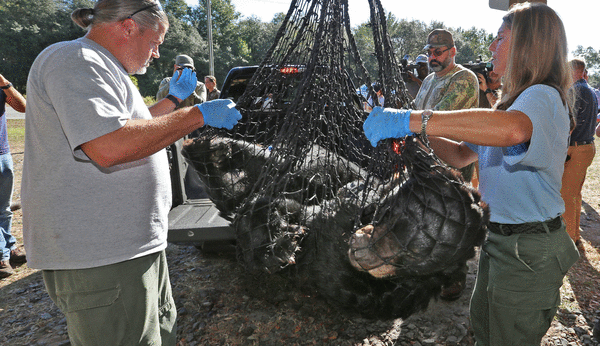
ORLANDO, Fla. — Hunters will fan out across Florida beginning Saturday as the first sanctioned hunt of black bears in a decade kicks off amid sharply divided public opinion and efforts by humane advocates to cajole — and even pay — sportsmen not to shoot the state’s largest land mammal.
Through a lottery system, state wildlife officials awarded 172 bear tags last month to people with a hunting license, each good for a one-bear “harvest,” the term the state Fish & Wildlife agency uses for a kill.
Some say the hunt, now authorized as an annual event, is overdue given the surge in the species’ numbers. “My perspective on this slowly changed as I witnessed the population boom and the havoc it is causing,” said Ian, a hunter from Volusia County who responded to an Orlando Sentinel survey of tag holders but asked to be identified by first name only. State officials estimate there are more than 4,000 bears in Florida today, up from a low of several hundred in the 1970s.
But as many as 50 tag holders won’t hunt, said Susannah Randolph, who heads Sierra Club Florida, which launched a strategy to “bag a tag and spare a bear.” The organization co-funded lottery entries with other moneyed conservationists and animal “rescuers” like businessman Steve Rosen who said he ponied up more than $200,000 to win tags that would not be used.
Each application cost $5.
Even one dead bear is too many, said Katrina Shadix, founder of Bear Warriors United, a Central Florida-based, not-for-profit advocacy group which unsuccessfully sued the Florida Fish & Wildlife Conservation Commission in Tallahassee to block the hunt.
A judge last month rejected arguments the wildlife agency had used bad science and “stale” population data to set harvest goals.
On the Bear Warrior Facebook page, Shadix then offered $2,000 to bear-tag holders not to hunt. She said 20 hunters signed on.
“They needed money to pay bills,” Shadix said.
Chuck Echenique, a lifelong hunter from the Tampa area, said he suspects the Bear Warrior numbers are exaggerated. He estimated about 30 people who won bear-tags are non-hunters who submitted hundreds of lottery entries to thwart FWC’s bear management plan.
About two dozen recipients paid $1,750 each for 350 entries, state records show. Four others spent $2,000 for 400 entries each.
Echenique said he will be part of a hunting party that includes two permit-holders on private land in northern Florida, where trail cameras regularly spy large male black bears roaming the woodlands near the Florida-Georgia line and the Osceola National Forest.
The hunt, which ends Dec. 28, was set late in the year to limit risk to female bears which are more likely to be denning with cubs.
“It’s not going to be an easy hunt,” Echenique said, citing a rainy forecast and the tendency of male bears to move at night.
He predicted about 100 bears will be harvested in this hunt, which FWC expects to hold annually.
Hunters killed 304 bears in 2015, a scheduled seven-day season halted after two days as kills neared the 320 harvest goal.
The Sentinel obtained a list of licensed hunters awarded a bear permit through FWC’s tag lottery, then emailed questions to the applicants given permission to hunt in the Central Florida bear management area’s hunting zone; tag holders with addresses in Orange, Lake, Seminole or Volusia counties; and out-of-state applicants who won a permit to kill a Florida bear.
Most who replied said they would not hunt bears.
“I hope they are all hiding,” said Janis Ingham of Casselberry.
“This is Florida not the isolated parts of Alaska where a bear might provide food and clothing to a family,” she replied in an email to the newspaper. “We have a market on every corner and have no need to hunt, especially bears. Additionally, due to over development, the bear management units are fragmented to the point that bears are unable to safely cross ranges which is impacting their genetic diversity.”
“I’m saving a bear’s life is how I look at it,” said Sandra, an Orlando woman who submitted five applications (total $25) to win one of the 18 non-transferrable permits to hunt in the Central Florida bear management zone that includes Orange, Lake and Seminole counties.
She asked to be identified by her first name only and described herself happily as a “tree hugger.”
A Eustis woman named Jill, who submitted 350 applications to win a hunting tag she won’t use, described the genetically unique Florida black bear as a “beautiful keystone animal in Florida’s increasingly fragile ecosystem.” Her success in the permit lottery, she wrote, “will be measured by allowing a bear to continue living its life in the wild rather than becoming someone’s hunting trophy.”
Some who plan to pursue bears said they understood opposition to the hunt but disagreed with it.
Jason Cannon, 42, a Georgia hunter awarded a tag to hunt for bear in the eastern Panhandle, criticized the Sentinel’s “heavy slant towards degrading hunters, and for that matter undermining efforts by the FWC who are just doing their best to regulate natural resources.”
He asserted said the “anti’s” strategy to keep bear-hunt permits out of the hands of hunters will backfire in the long run. “If the quotas aren’t met there are only a few options FWC has to correct that in future years, all of which have the potential to cause more damage than good,” he wrote.
Christopher Silvey, 52, a member of a Central Florida hunt club, said he has hunted all over the world, including in Russia where he killed three large brown bears. In his reply, he said, if successful, he would have the bear processed and the hide turned into a rug.
“People who are anti-hunting have accumulated too much wealth and know nothing about survival and what it truly means to be a man,” he wrote. “We were created to be the Apex Hunters. You can look that up in Genesis. God gave us dominion over the animal kingdom.”
©2025 Orlando Sentinel. Visit orlandosentinel.com. Distributed by Tribune Content Agency, LLC.






Comments