DeSantis, House differ on when to redistrict Florida maps amid Trump push
Published in News & Features
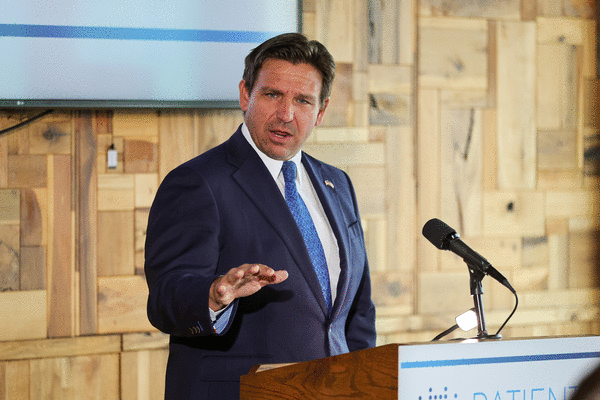
TALLAHASSEE — Gov. Ron DeSantis and Florida House Republicans appear ready to throw Florida into a mid-decade redistricting battle. But they don’t agree on when to start.
Over the summer, President Donald Trump began pushing for red states to redraw their maps to protect the House Republican majority in the upcoming midterm elections and add more GOP-leaning seats.
At the time, DeSantis was coy, telling people to “stay tuned” about what may happen in Florida.
But earlier this month, he said he would push to redraw the state’s congressional map sometime next spring — after the end of Florida’s 60-day regular legislative session, which begins in January. DeSantis said earlier this week that his staff hasn’t drawn up any maps yet, but “we’re going to do it.”
But the House is considering moving forward more quickly.
On Thursday, the chamber’s select committee on redistricting held its first meeting, and chairman Mike Redondo signaled that it was possible the House could craft a new map during the regular session.
“Given the fact that we are less than a year away from the election ... it would be irresponsible to delay the creation and passage of a new map, especially until after session,” said Redondo, R-Miami.
He clarified that the House “may ultimately or may not” move forward on a new map.
If the House moves forward during the regular session, it may be going alone. Senate President Ben Albritton said Wednesday that the Senate, like DeSantis’ office, isn’t working on a map now.
During the House committee meeting, GrayRobinson attorney Andy Bardos, who serves as outside legal counsel for the House, gave a presentation on how redistricting works.
No public comment was permitted, but the presentation was watched by a full room of people opposed to the unusual mid-decade redrawing of borders.
When Redondo, during his nearly 10-minute opening address to the committee, said the work is “not directed by the work of other states and partisan gamesmanship,” attendees let out a vocal, embittered laugh.
Redondo said the House was looking into questions raised by a recent Florida Supreme Court ruling dealing with redistricting.
He said the committee may also consider a forthcoming U.S. Supreme Court case dealing with the Voting Rights Act. DeSantis has said he thinks Florida will be “forced to” redistrict following the conclusion of that case.
The nation’s high court appears ready to weaken a key provision of that law that prohibits racial discrimination in voting practices.
DeSantis said if Florida redistricts, he didn’t think there would be room for a federal challenge.
In 2019, the U.S. Supreme Court said gerrymandering shouldn’t be ruled on by the federal courts, putting the question of whether a map is fair primarily in state hands.
“Basically, the Legislature’s going to have to pass maps that just comply with the Florida Constitution,” DeSantis said earlier this week.
Florida voters in 2010 passed the Fair Districts amendment, which says that no map can be drawn to help or harm a political party‘s electoral chances.
Opponents of Florida’s plan to redistrict this year say the state’s move is political.
Genesis Robinson is the executive director of the left-leaning civil rights group Equal Ground. In 2022, Equal Ground challenged the map previously drawn by DeSantis’ staff as an unconstitutional race-based gerrymander. The Florida Supreme Court upheld the map earlier this year.
Robinson said that DeSantis got his preferred map, so an attempt to change it again now “shows us that this is about other motivations.”
“The governor can roll out whatever rationale that he wants,” Robinson said. “But we know there was no conversation of redrawing our maps until the president made the call for states to do so to give them a better chance of holding power in Congress.”
Florida’s regular legislative session begins in January and is scheduled to end March 13.
Waiting until the spring after the session concludes to redistrict would mean the new map could leave federal candidates for 2026 scrambling; candidate qualification ends April 26.
If the state passes a new map this year, it could be in place for the 2026 elections, regardless of any legal challenges.
Take 2012 as an example. Florida’s Legislature redrew and passed new maps as part of the standard, once-a-decade redistricting process.
After being approved by then-Gov. Rick Scott, lawsuits piled up challenging the maps as an unconstitutional gerrymander.
Two election cycles, 2012 and 2014, passed before the Florida Supreme Court invalidated the state’s map in 2015 and approved a redrawn proposal.
_____
©2025 Tampa Bay Times. Visit tampabay.com. Distributed by Tribune Content Agency, LLC.





Comments