After ominous signs from 7th Circuit, attorneys abruptly move to dismiss lawsuit restricting use of force by immigration agents
Published in News & Features
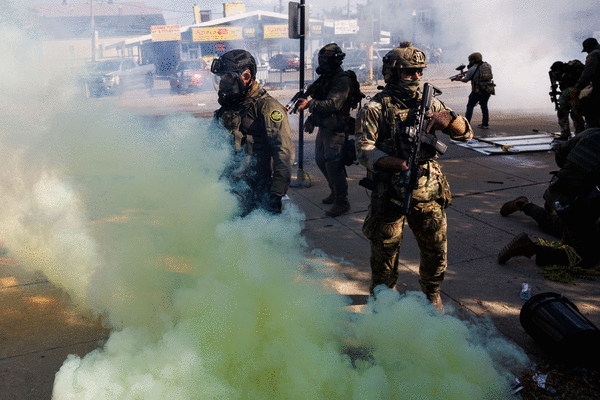
In what appears to be a longer-term legal strategy, the plaintiffs in an injunction case limiting the use of force by immigration agents during Operation Midway Blitz on Tuesday abruptly moved to dismiss the underlying lawsuit in the midst of an appeal by the Trump administration.
In the request, lawyers representing a consortium of media outlets and other plaintiffs noted that the immigration enforcement surge “has ended” in Chicago — at least for now — and that “counsel has not received a single report of unconstitutional behavior that necessitated this case” since Nov. 8.
If the dismissal is granted, it could effectively end a case that came to symbolize the havoc Midway Blitz caused in Chicago and led to U.S. District Judge Sara Ellis issuing a scathing ruling limiting the use of tear gas or other munitions against journalists and protesters, among other restrictions.
In a statement Tuesday, the board for the Chicago Headline Club, the lead plaintiff in the case, claimed victory, saying that Border Patrol Cmdr. Gregory Bovino and his team of agents left town soon after Ellis’ injunction was entered.
“To no one’s surprise, the federal government appealed, and the lower court’s preliminary injunction was stayed in the meantime,” the statement said. “Given that the Border Patrol and other federal agencies have reduced their presence for now, we don’t see a need to keep the court fight going. We’ll take the win.”
Lead plaintiffs’ attorney Steve Art said the litigation exposed the brutality behind the Trump administration’s immigration enforcement and showed that its justifications for the use of force were “blatant lies.”
“Judge Ellis’s powerful opinion stands as the final word in this case, and as a defining document of our time,” Art said in a written statement.
Meanwhile, the Chicago Headline Club said that it was “fully prepared to go to court again if federal agents return in force or if any activities of federal agents escalate into violations of our constitutional rights.”
According to the motion to dismiss, the Department of Justice has agreed to drop its appeal as long as Ellis dismisses the lawsuit “with prejudice,” meaning it cannot be refiled.
A DOJ spokesperson was not immediately available for comment.
The decision to drop the case came after ominous signs from a conservative three-judge panel with the 7th Circuit U.S. Court of Appeals, which issued an emergency stay of Ellis’ injunction last month. It’s not immediately clear if the appeals court would drop the matter entirely. The court had issued an expedited briefing schedule and set arguments for later this month.
In asking the 7th Circuit for a stay, lawyers for the U.S. Department of Justice wrote earlier this month that the case was a “perfect example” of a growing trend in the nation’s courts to issue sweeping injunctions that violate the separation of powers and “superintend law-enforcement activities under threat of contempt.”
Days later, a conservative three-judge panel of the 7th Circuit granted the stay and set the case for expedited briefing, saying the government was likely to succeed on those arguments.
“The preliminary injunction entered by the district court is overbroad,” the order said. “In no uncertain terms, the district court’s order enjoins an expansive range of defendants, including the President of the United States, the entire Departments of Homeland Security and Justice, and anyone acting in concert with them. … The practical effect is to enjoin all law enforcement officers within the Executive Branch.”
Ellis’ injunction also requires government officials to submit all future guidelines for use of force to the court for review, “a mandate impermissibly infringing on principles of separation of powers on this record,” the appeals court said.
The injunction was also too “prescriptive” in barring the “use of scores of riot control weapons and other devices in a way that resembles a federal regulation,” the appellate court order said.
All three judges on the panel hearing the appeal are Republican nominees. Judge Frank Easterbook was nominated by President Ronald Reagan, while Judge Michael Scudder and Judge Michael Brennan were each nominated by Trump in his first term.
While the judge’s warned not to read too much into its order for a stay, it was clear that the court was poised to severely limit — if not overturn — Ellis’ injunction, which could have greatly hampered any future efforts to rein in immigration enforcement practices should it pick up again in the spring.
In her injunction ruling, Ellis earlier this month revealed new information gleaned from body-worn cameras and other evidence showing how agents used tear gas and flash-bang grenades on fleeing protesters, shot a praying minister in the face with pepper balls and even used ChatGPT to help write a report.
The 233-page written ruling took readers methodically through many of the high-profile melees between immigration agents and protesters during the two-month operation, including incidents in Albany Park, Old Irving Park, Evanston and the East Side.
Ellis wrote in the opinion that, over and over, body-worn camera footage from the agents undermined what was eventually put in their use-of-force reports, rendering their statements unreliable.
The reports also misidentified “neighborhood moms and dads, Chicago Bears fans, people dressed in Halloween costumes, and the lawyer who lives on the block” as professional agitators, Ellis wrote, while the body cameras at times captured the agents’ apparent glee in deploying tear gas and other munitions on residential streets.
Ellis’ preliminary injunction prohibits immigration agents from deploying tear gas or other munitions before issuing two explicit warnings, requires agents in the field to have body cameras and wear clear identification on their uniforms and forbids law enforcement from targeting journalists or interrupting their news gathering in most circumstances.
Unlike a previously entered temporary restraining order, the preliminary injunction was to remain in effect until a final decision on the merits of the case is made, either at trial or through a settlement. Ellis had tentatively set a hearing on permanent injunction for March.
In its appeal brief filed last week, the Department of Justice argued Ellis’ injunction order was “untenably overbroad” and improperly empowers her to “micromanage how federal agents respond to disruptive and often violent protests throughout the Chicago area.”
“What began as a complaint by a handful of journalists and protesters alleging that federal officers targeted them with crowd-control devices at a few protests in September and early October has transformed into an instrument for judicial micromanagement of federal law-enforcement operations,” lawyers for the Department of Justice wrote in the brief. “The injunction broadly obstructs the enforcement of the nation’s laws, chills the exercise of executive power, and subverts the constitutional structure.”
____
©2025 Chicago Tribune. Visit at chicagotribune.com. Distributed by Tribune Content Agency, LLC.





Comments