How Trump, Rubio and others are using social media to sell Venezuela actions
Published in News & Features
In the early months of President Donald Trump’s second term, administration officials turned to social media to describe an “invasion” of the United States by Venezuelan gangs. They used it to justify their efforts to deport thousands who had fled Nicolás Maduro’s regime.
Homeland Security Secretary Kristi Noem, for instance, posted about ending Venezuelans’ temporary protected status, saying the Biden-era policy allowed Venezuelans to illegally enter the country and violate U.S. laws.
A few months later, the story shifted.
Posts by Trump, Secretary of State Marco Rubio and other officials started to depict Maduro himself as the head of a drug cartel and link him to fentanyl deaths in the U.S., though there is scant evidence that the country is involved in large-scale production or distribution of the synthetic opioid. Their posts portray the Maduro regime as an international security threat.
U.S. officials’ messaging about the country this year has dovetailed with the administration’s shifting policy priorities, a Miami Herald review of more than 56,000 posts on X (formerly, Twitter) from three dozen accounts show. And their posts have become more negative and angrier with time.
The U.S. meanwhile has blown up dozens of boats and killed scores of people it alleges were drug-traffickers in the Southern Caribbean. And U.S. warships and planes now stand poised to conduct military strikes inside Venezuela.
One of Trump’s key promises on the campaign trail was that the U.S. will no longer fight wars abroad. Projecting the current military buildup in the Caribbean as part of the “war on drugs” potentially allows the U.S. to portray the lethal strikes as a policing action rather than an intervention in the affairs of another country.
The amped up rhetoric in U.S. officials’ social media posts are a way to “prepare the ground” for the possibility of a military strike on Venezuela, said Christopher Hernandez-Roy, an expert on the region with the Center for Strategic and International Studies.
The White House and the State Department did not answer specific questions from the Herald about the administration’s public messaging, the military deployment or how the standoff could end.
Anna Kelly, a spokesperson, said that all the strikes were against “designated narcoterrorists bringing deadly poison to our shores.”
“The President will continue to use every element of American power to stop drugs from flooding into our country and to bring those responsible to justice,” she said.
War of words
Since his appointment as Secretary of State, Rubio began linking Maduro to drug trafficking in social media posts for the first time only on July 27.
The next day Attorney General Pam Bondi announced a $50 million reward for Maduro’s arrest on narcoterrorism charges and a few days later, the State Department posted a video where Rubio declared that the United States does not “recognize that [the Venezuelan] government is legitimate.”
Rubio described Maduro as the “head of the vicious Cartel de Los Soles” in a post on the night of August 8. Two weeks later, the first U.S. Navy warships steamed into the Southern Caribbean.
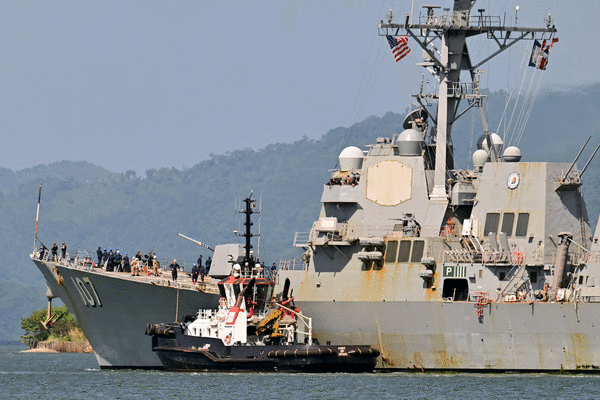
Since the three Aegis-guided missile destroyers first arrived off the coast of Venezuela in late-August, surveillance airplanes from the U.S. Naval Airbase in Jacksonville, Fla. have flown sortees in the region, bombers have circled off Venezuela’s maritime borders and thousands of U.S. ground troops are deployed in the roughly dozen ships now in the area.
U.S. fighter jets, drones and gunships have carried out lethal strikes killing at least 86 pub individuals.
The U.S.S. Gerald R. Ford, the world’s largest aircraft carrier, arrived in the Caribbean on Nov. 16.
The military is also upgrading the runways at Roosevelt Roads, a previously abandoned naval base in Puerto Rico, satellite photos obtained by the Herald shows. The upgrades would enable fighter jets and cargo planes to use the base. The renovations indicate that the U.S. is looking to maintain a sustained and long-term aggressive posture in the region, military experts told the Herald.
“This is a use of hard power to provoke a change,” said Hernandez-Roy. “The administration is trying to scare the pants off of Venezuela.”
Maduro, for his part, has mobilized millions of Venezuelans in the Bolivarian militia — a reserve force created by the late President Hugo Chávez — to support the country’s military in the event of an attack from the United States. He warned last week that attacking the country would end Trump’s political career.
Questions abound about the administration’s broad assertions regarding Venezuela on social media and elsewhere.
Earlier this year, criminologists and experts on the region questioned the Trump administration’s claims about Tren de Aragua members being controlled by the Maduro regime and flooding into the United States. More recently critics have again questioned U.S. officials’ assertions that the boats it has blown up in the Caribbean were carrying drugs and also the broader claim that Venezuela is a major player in fentanyl trafficking.
While Trump posted about combating fentanyl trafficking when the strikes first began in September, recent posts by him and other administration officials and agency social media accounts have been vaguer only using broad words like “drugs” and “narcotics”, without specifying a type, the Herald found.
The administration is yet to produce any evidence to the public that the individuals it has killed are drug-traffickers, leading to concerns both in Congress and among U.S. allies that the lethal strikes may be illegal.
‘Element of hope’
Open opposition to the Venezuelan regime has long been a focus of both Trump and Rubio.
The U.S. Justice Department under the first Trump administration indicted Venezuelan President Nicolás Maduro for allegedly collaborating with the left-wing guerrilla group, Revolutionary Armed Forces of Colombia and “flooding” the United States with cocaine in early-2020. Federal prosecutors also argued that Maduro had grown to become leader of the Cartel de Los Soles — “Cartel of the Suns” — an informal organized crime syndicate that is generally believed to be headed by high-ranking members of the Venezuelan military.
U.S. officials last year questioned the integrity of Venezuela’s elections last year after Maduro declared victory. They noted that tally sheets obtained from local polling stations by the opposition and independent observers show a different outcome than that announced by the country’s election administrators.
But the remarkable military buildup in the Southern Caribbean — around a tenth of the American global fleet is now deployed in the area — marks a new phase in tensions between Washington and Caracas.
The escalation of tensions has gone hand-in-hand with public messaging about Venezuela from U.S. government officials and agencies, the Herald found.
The frequency with which officials and social media accounts of government agencies have posted about how Venezuela and the Maduro regime is a foreign and military problem have dramatically increased leading up to and since the military deployment.
Social media is a better medium for political figures to get their ideas across since it removes any moderation or interference with their messages like the fact-checks a traditional news outlet may provide, said Pinal Yildrim. Yildrim is a University of Pennsylvania professor who studies political messaging and social media.
Since social media is already based on followers with common interests, officials or lawmakers posting about a policy automatically get amplified by their base.
“In some ways it is like preaching to a choir,” said Yildirim but warned against over-generalizing about any trends since every situation or social media user is different.
The recent posts on the Maduro regime and the military strikes, the Herald found, have received nearly 1.5 million views on average — five times more than posts which position the influx of undocumented Venezuelan immigrants as a domestic issue.
The nearly two dozen lethal strikes in the Caribbean so far have proven controversial with even long-time U.S. allies like the United Kingdom, which has reportedly paused intelligence sharing out of concern that the military actions may be illegal.
Some prominent figures in the Venezuelan community in South Florida urged caution but all told the Herald that they saw the U.S. military presence as an “element of hope” that may bring about the fall of the Maduro regime.
Maria Corina Machado, Venezuela’s top opposition leader and winner of this year’s Nobel Peace Prize, called Trump’s strategy “absolutely correct” at the America Business Forum in Miami earlier this month.
Echoing U.S. officials, she called Maduro “head of a narco-terror structure” and said Trump is working to disrupt the “drug trafficking, gold smuggling, arms and human trafficking” networks in the region.
“Maduro started this war,” she said. “President Trump is ending it.”
--------
—Miami Herald staff writer Antonio Delgado and McClatchy’s Susan Merriam contributed reporting.
©2025 Miami Herald. Visit at miamiherald.com. Distributed by Tribune Content Agency, LLC.





Comments