Boeing moves more 787 work from WA
Published in Business News
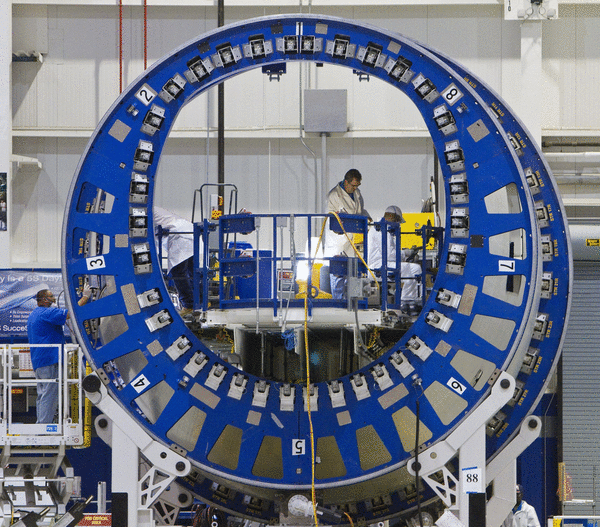
Boeing will move engineering work for the 787 Dreamliner from the Puget Sound region to South Carolina, marking another move away from Washington five years after it shifted all final assembly for the 787 from Everett, Washington, to North Charleston.
Boeing told employees last week the “remaining 787 engineering work” would move from its Puget Sound base to North Charleston, according to the union representing engineers and technicians, the Society of Professional Engineering Employees in Aerospace.
SPEEA expects about 300 workers will be impacted.
It’s not clear if the change will result in layoffs in the Puget Sound area, or if any nonunion workers will be affected. It’s also unclear when the work will transition from Washington to South Carolina, a spokesperson for SPEEA said.
Boeing said Thursday it is hiring a significant number of engineers" in the Puget Sound area to support the 737 program and in South Carolina to support increased production of the 787. Boeing currently produces the 737 in Renton and has plans to open a fourth MAX assembly line in Everett.
Engineers will be "co-located with the programs they support, a Boeing spokesperson said Thursday.
Boeing originally built the 787 in Everett, before expanding production to Charleston in the mid-2000s and opening a second final assembly line there in 2010. Ten years later, it announced it would consolidate all 787 work on the North Charleston campus and close the final assembly line in Everett.
The decision rattled the Puget Sound area, where elected officials and union leaders worried about what the move would mean for Washington’s aerospace economy and future. Boeing said at the time the decision was a cost-saving measure, driven by the COVID-19 pandemic and resulting slowdown in air travel.
Some saw Boeing’s South Carolina growth as a swipe at the Washington unions; Boeing’s workforce in South Carolina is not unionized and the company announced its initial shift away from Washington shortly after a 2008 Machinists strike that halted 787 production for 57 days.
The latest decision to move engineering work away from Washington again rattled leaders of SPEEA, which is preparing for contract negotiations for its Puget Sound contingent. The contract expires in October.
The union’s local chapter has 17,000 Boeing employees who are largely based in Washington, with some in Oregon, California and Utah. SPEEA's professional unit includes engineers and scientists, while its technical unit includes analysts, planners, technicians and skilled tradespeople.
Boeing did not tell union leaders about its plans at a committee meeting meant to keep the union informed of any company decisions that could impact members, SPEEA executive director Ray Goforth said in a statement.
“Worse yet, the company has not yet answered basic questions about timing and process of the move,” Goforth said. “Our members have very legitimate concerns about their future with the company and how long they can expect to earn a paycheck in their current roles.”
Boeing’s Washington workforce dipped 4% last year, reflecting sweeping layoffs announced in 2024 amid a tumultuous financial year, including the midair fuselage blowout that January and a Machinists strike that halted production in Boeing’s Puget Sound factories that fall.
The company’s total workforce, though, grew 5.5% in 2025, due to its acquisition of supplier Spirit AeroSystems. The deal, which closed in December, added about 17,000 employees to Boeing’s global head count.
Taking Spirit out of the equation, Boeing’s total head count would have decreased by 4.3%.
With more than 65,000 workers, Washington still accounts for Boeing’s largest swath of workers.
The company has about 9,000 employees based in South Carolina, according to employment data released last week. Boeing broke ground last year on a $1 billion expansion of its South Carolina campus, expanding its footprint to enable higher 787 production rates.
Meanwhile, Boeing is laying off about 300 workers from its defense division supply chain. Those cuts, which will impact workers at several sites, will not affect SPEEA or members of the Machinists union in the Puget Sound.
©2026 The Seattle Times. Visit seattletimes.com. Distributed by Tribune Content Agency, LLC.










Comments