Dream of owning a flying car? This California company is already selling them
Published in Business News
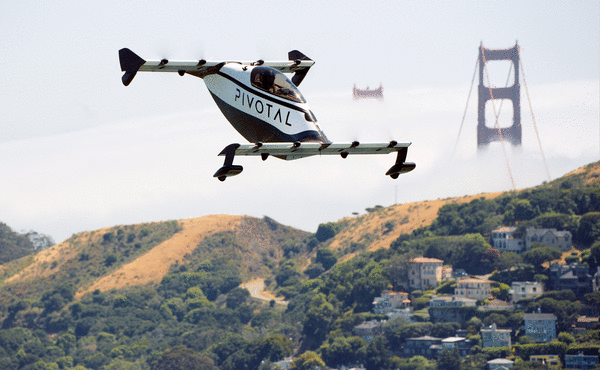



A future with flying cars is no longer science fiction — all you need to order your own is about $200,000 and some hope and patience.
The Palo Alto-based company Pivotal has been developing the technology since 2009 and is nearly ready to bring it to market. The company's founder Marcus Leng was the first to fly in its real-life version of a flying car in 2011.
Leng engineered an ultralight, electric-powered vertical takeoff and landing aircraft known as an eVTOL. Other VTOL aircraft, such as helicopters, had existed for decades, but Leng's invention was fixed-wing and didn't rely on gas.
The Canadian engineer dubbed his creation BlackFly and spent years working on it in secret.
The company moved to the Bay Area in 2014 and by 2018 had developed a second version of BlackFly that laid the groundwork for Helix, the aircraft Pivotal now offers for sale.
"The company kind of came out of stealth at that point and said, 'This is what we're up to,' " said Pivotal Chief Executive Ken Karklin, who took over company leadership from Leng in 2022.
Those who are curious — and wealthy — can reserve a Helix today with a $50,000 deposit. The aircraft starts at $190,000 with the option of purchasing a transport trailer for $21,000 and a charger for $1,100.
A customer who makes their reservation today could receive their aircraft in nine to 12 months, Karklin said. It takes less than two weeks to learn how to fly it.
In order to complete Pivotal's flight certification training, a customer has to pass the FAA knowledge test and complete ground school. Training, which takes place at the company's Palo Alto headquarters and at the Monterey Bay Academy Airport, teaches customers how to control and maintain the aircraft, as well as how to transport and assemble it.
Pivotal, formerly known as Opener, publicly introduced the BlackFly in July 2018. In October 2023, the company unveiled Helix, calling it the first scalable aircraft of its kind.
A handful of California companies are using eVTOL technology to develop what they call air taxis to shuttle people around congested cities. But Pivotal says it offers something different: a single-person aircraft for recreational use and short-haul travel that also has the potential to support emergency response and military operations.
It is uncertain how fast the company and others like it can ramp up production and how communities will react. Not everyone is on board. Darlene Yaplee, president of the Aviation-Impacted Communities Alliance, said there are concerns about having different types of aircraft in limited airspace.
Pivotal has around six early-access customers who already own a version of the BlackFly and are flying it for fun. The aircraft is designed to be accessible and user-friendly, and you don't need a pilot's license to operate it.
Tim Lum, a Washington state resident, bought his BlackFly in 2023. He's since taken it on around 1,200 flights in 100 different locations across the U.S.
Lum, who isn't an FAA-certified pilot, said owning a BlackFly is like a dream. He can take off and land anywhere with 100 feet of clearance and permission if on private land. He also uses small, private airports.
The aircraft is stored in Twisp, Wash., but Lum has towed it coast to coast, stopping to fly in states such as Florida, Montana and California. He shares it with family and friends who also trained to get certified by the company.
"Something really happens to the synapses in my brain when I'm flying," Lum said. "Things get sorted out and things make sense. This has opened up more doors for me and the people that I care about than money can buy."
The Helix is classified as a Part 103 ultralight aircraft, the same regulatory class as a hang glider. It's meant to be flown less than 200 feet high, in unregulated airspace, and weighs about 355 pounds empty.
Karklin said the company has received about a year's worth of reservations for Helix. He did not specify the number of customers but said it was more than 10.
Karklin has been getting Pivotal ready for a wider market. The company, which has more than 100 full-time employees, has trained just over 50 people to fly its aircraft. Customers and employees have been trained.
Pivotal's business will operate across three segments, Karklin said, including personal use, public safety and defense.
"You're going to see business generated by all three," he said. "We talk about recreation and short hop travel, and sometimes folks can be a little dismissive about that. I think that's a huge mistake."
In 2023, Pivotal leased eight aircraft to an innovation arm of the U.S. Air Force and defense technology firm MTSI. The Air Force conducted nondevelopmental testing and evaluation of the vehicle that informed the latest version of Helix.
Helix will have an electric range of about 30 minutes and a cruise speed of 62 mph, the company said. It takes 75 minutes to charge it using a 240 volt charger.
The noise produced by the aircraft during takeoff and landing is equivalent to a couple of leaf blowers, Karklin said. When flying it is overhead, someone on the ground might not be able to hear it.
Karklin said the simplicity of the aircraft comes with lower cost, lower weight and higher safety. The aircraft, which has only 18 moving parts, is full of redundancy to prevent system failures.
It's been independently evaluated by the Light Aircraft Manufacturers Assn., and Pivotal's quality management system has received a certification from SAE International, which sets aviation safety standards.
The company completes flight demonstrations frequently at the Monterey Bay Academy Airport, near the coast in Watsonville.
When Helix flies, it turns heads, Karklin said.
"It's starting to get very real," he said. "More people can actually see it in person and touch it and feel it. And then they want to get on."
©2026 Los Angeles Times. Visit at latimes.com. Distributed by Tribune Content Agency, LLC.








Comments