Boeing warned 15 years ago about part problem at center of UPS crash
Published in Business News


More than a decade before a deadly crash last year, Boeing warned MD-11 operators that a part securing the cargo plane’s engines to their wings had failed four times, while insisting it did not pose a safety risk.
Now that piece is the focus of an investigation into the UPS Flight 2976 disaster in Kentucky.
In a memo Wednesday, the National Transportation Safety Board said Boeing sent a letter to MD-11 operators in February 2011 describing previous failures of a piece called the “spherical bearing race,” a small but critical piece that helps to hold the airplane’s engine to its wing. Boeing’s letter said the failures did not pose a safety risk, the NTSB said.
In its preliminary report regarding the Nov. 4, 2025, crash, the NTSB found evidence of fatigue cracking and overstress on the same piece.
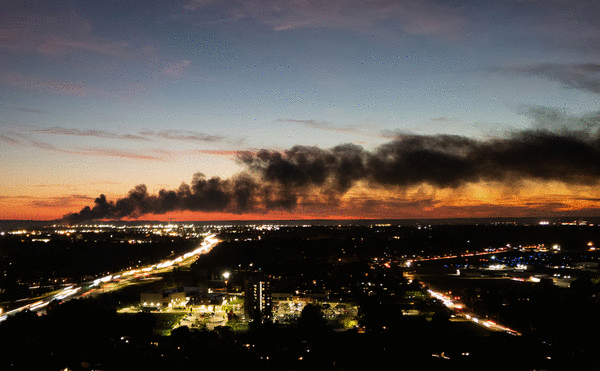
The safety board is still investigating the deadly MD-11 crash, which killed three crew members on board and 12 people on the ground. The UPS cargo plane, built by McDonnell Douglas in 1991 six years before the company merged with Boeing, was taking off from Louisville and heading toward Honolulu when the plane’s left engine separated from the wing and caught fire. The plane struggled to gain altitude and crashed into three nearby buildings.
The crash grounded the MD-11 fleet, as well as similar DC-10 cargo planes. The MD-11 is no longer in production but UPS, FedEx and Western Global Airlines still use it to transport cargo around the world.
In its preliminary report, the NTSB focused on the equipment that secures the plane’s engines to its wings. The left and right engines are attached to the underside of pylons, which are then attached to the underside of each wing.
The pylon attachment consists of several pieces of hardware, including a forward and aft mount bulkhead and thrust link assembly. Those pieces have their own sets of hardware, including the spherical bearings and fittings bolted together with lugs.
In its preliminary report, the NTSB found fractures on the left pylon aft mount lugs and spherical bearings and evidence of “fatigue cracks” and “overstress failures.”
In its update posted Wednesday, the NTSB said the cracking on the spherical bearing race went through the thickness of the entire piece, toward the exterior surface. Fatigue cracking accounted for 75% of the fractured surface, while overstress failure accounted for the other 25%.
The fatigue cracking originated at the edge of the design recess groove on the interior surface, the NTSB continued.
Boeing’s service letter from 2011 described four instances on three MD-11 airplanes of similar failures that initiated at the same spot, the NTSB report said.
In those events, the bearing race split into two pieces and the separated pieces moved away from the lugs which normally encompass the entire structure. Boeing’s letter said the failure was visible because the fractured pieces had moved beyond the outer surface of the lugs.
The letter instructed operators to inspect the assembly during the general visual inspection and to conduct a detailed visual inspection of the pylon aft mount every five years.
Boeing also updated its aircraft maintenance manual to include a visual inspection of the piece by checking that the spherical bearing race was not protruding beyond the lugs.
The letter went on to discuss a new type of spherical bearing assembly, which would have eliminated the design recess groove. It recommended operators install the new assembly if they found an issue with the existing spherical bearing but did not mandate the switch.
The MD-11 plane that crashed in November had undergone a general visual inspection in October 2021. Following UPS’ maintenance program, it wasn’t due for another detailed inspection for about 7,000 more takeoffs and landings.
UPS had worked on the plane to lubricate the pylon thrust links and spherical bearings on Oct. 18, just a few weeks before the crash.
The NTSB said Wednesday it is investigating the spherical bearing assembly inspection, Boeing’s maintenance planning documents and manuals and UPS’ incorporation of the service letter in its MD-11 maintenance program.
The safety board is also reviewing Boeing’s correspondence with its regulator, the Federal Aviation Administration, regarding the service letter. Boeing could not immediately be reached for comment Wednesday.
©2026 The Seattle Times. Visit seattletimes.com. Distributed by Tribune Content Agency, LLC.








Comments